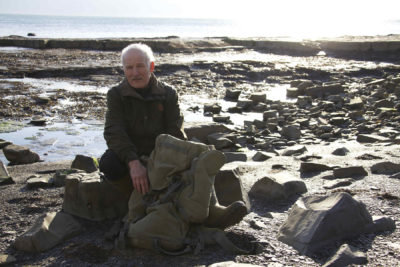
Some 50 years after he left school without a qualification to his name, Steve Etches is still cocking a snook at Academia. In those days all he had to back himself up was self-belief, but today he has an MBE for services to science, a string of awards from his peers and an international reputation as one of the world’s leading palaeontologists.
His work in collecting, preparing, cataloguing and interpreting fossil specimens drawn from Kimmeridge Clay is transforming what we know of the Jurassic era and life on Earth some 150 million years ago. Next summer will see the opening of The Etches Collection, a £2.7 million Lottery funded community resource that will be home to the most significant assemblage of Kimmeridgian fossil finds in the world, a collection that currently fights for house space just down the road in the Kimmeridge village home Steve shares with his wife Sue.
Although rightly proud of what he has achieved, Steve’s more excited by the prospect of his life’s work being available to all to study, research and develop. As a self-taught specialist he’s used to being considered something of a maverick, but his passionate pursuit of the practical understanding of the species he has dragged from the rocks is every bit as rigorous as that employed by the eminences of that world – perhaps even more so. At the last count he has uncovered at least 20 new species.
‘Kimmeridge Clay has been described as the least interesting of all of the Jurassic rocks to the British fossil collector and been dismissed as having little to offer in the way of good fossil specimens, my quest has been to show that’s not so and I’m proud to say that I believe I have achieved that,’ he says.
If it’s difficult for the layman to understand the significance of what has become known as The Etches Collection we can call on the help of Charles Darwin who spent years researching fossilised barnacles in the pursuit of empirical evidence with which to test his theories on evolution. In Steve’s collection is a Crestiscalpellun that’s the oldest barnacle, by some 36 million years, to show any sign of colour retention.
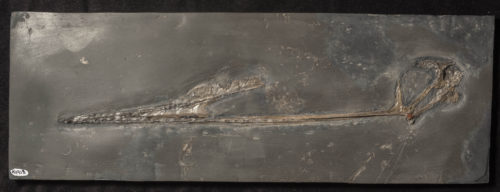
‘It’s the missing link that Darwin was searching for and it’s just in there,’ says Steve, nodding to the humidity-controlled dining room and annexe where 2000-odd specimens are currently stored. Another new genus of barnacle that’s still living in the seas off Japan is also in there, as is the first pterosaur (flying reptile) skull found on the Dorset coast for 200 years, a unique specimen. There’s a fully articulated ichthyosaur (marine reptile) that’s new to science and comes complete with its last meal of squid and fish; a scientific first in the shape of ammonite eggs; and other discoveries Steve is not yet ready to divulge.
‘They taught us dinosaurs were badly designed and stupid yet they walked the Earth for more than 200 million years. Man has been here for barely four million years and as a species we’re hell bent on ruining ourselves. The point is these aren’t dead rocks, they hold fossil evidence of living things and I want to know their complete story, how they lived, reproduced and died and how that relates to other creatures from the time.’
Steve grew up near Throop and found his first fossil at the age of five – he still has it, his mother having kept it in her sewing box for years. His interest piqued, by the age of 11 and armed with the Observer’s Book of Geology, he had taken to wandering off in search of fossils during family visits to the seaside.
‘I really wanted a proper geological hammer, but my dad bless him bought me a tilers hammer, which was good for breaking toffee but not much else. I didn’t really fit in at school so I was pretty rebellious against the curriculum. The teaching methods in those days, if you didn’t respond as you were supposed to do they put you on the scrapheap, that was you finished, but what I always say to the kids – and they’re the ones that matter most because they’re our future – is that if you really believe in what you’re doing anything is possible, it really is.’
Steve built a successful business as a plumber and heating engineer, married, had three children and rekindled his passion for palaeontology some 35 years ago.
‘What convinced me this is what I should spend my time doing was a massive pliosaur mandible that was poking out of a cliff at Kimmeridge. I dreamed of one day finding something that big and for four years I used to go there and just sit under it and imagine what I’d do with it if I ever got it.
‘Then, when Sue was pregnant with our youngest, I went down one morning and there it was on the beach covered in shale. I got as much of it as I could, wrecked my back for years getting it off the beach – didn’t matter, it got better. That Saturday I rounded up all the lads that worked for me and about ten of us got in the van and collected up the rest of it. We ended up with a near complete two-metre pliosaur mandible – a day or so later a storm washed the site away like it was never there.’
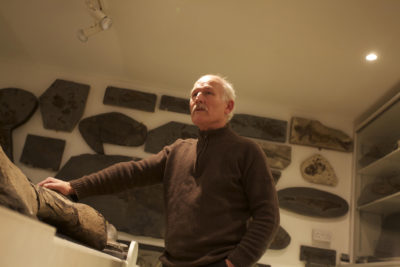
Having moved to Kimmeridge in the mid-1990s, Steve continued working as a plumber until about a year ago: ‘I should have made more of a success at the business really, but it has always been about funding this work,’ he confesses. Now he’s paid as collections manager for The Etches Collection. Ironically he cannot be named as curator of a public collection such as the one he has assembled … because he’s not qualified, even though academics have recognised the collection as one of the finest privately curated collections in Britain.
‘That doesn’t matter,’ he shrugs. ‘This is the culmination of everything I’ve wanted for the last 20 years. Visitors will also be able to see the workshop where the finds are prepared, which is a science in itself, so it won’t be a stuffy old museum in the traditional sense, it’ll be a place to educate and inspire for young and old.’
Expert or not, Steve will talk generously to anyone about his passions and it’s an odds-on bet that once he’s finished they’ll be many times more fascinated than they ever imagined.
• First published by Dorset Life – The Dorset Magazine in ‘Dorset Life in Purbeck 2015’