
As modern polymaths go few fit the bill quite as well as Paul Gough. A painter, author, broadcaster, producer, educator, academic, art historian, researcher and writer, his work has taken him all over the UK and Europe, as well as Australia, New Zealand and Hong Kong. In January, he was selected to exhibit in The Art of Creative Research at the NIE Gallery in Singapore.
He says he’s from ‘everywhere really’ having been to school in Aberdeen, polytechnic in Wolverhampton and gaining a Master’s degree in Painting from the Royal College of Art. His family home is in Bristol where he was Deputy Vice-Chancellor at the University of the West of England, before six years as Vice-President of RMIT University in Melbourne. Since 2020 he has been Principal and Vice-Chancellor of Arts University Bournemouth.
‘It’s fair to say I have a polymathic background,’ he acknowledges. ‘I am drawn to Dorset though, which I’m very happy about as I love it. As a painter, the light is incredible – I don’t know how many times I’ve painted on Flower’s Barrow above Tyneham looking down to Arish Mell; it’s stunning.’
Paul’s PhD is in First World War Art and while still at college he was commissioned by the Imperial War Museum to work with the Royal Marines at Hamworthy. That led to further work with tank regiments then stationed at Bovington Camp.
‘Working with the military was a great experience – I turned up at the Marines Base to find it under all sorts of alerts. Two armed sentries grilled me in the Guard House, I told them I was a painter, which caused some confusion as they thought I was there to paint their assault boats – out of several vast pots of grey paint – but it was all sorted out and they made me incredibly welcome. They seemed rather happy with the final paintings too – and there wasn’t too much grey!’
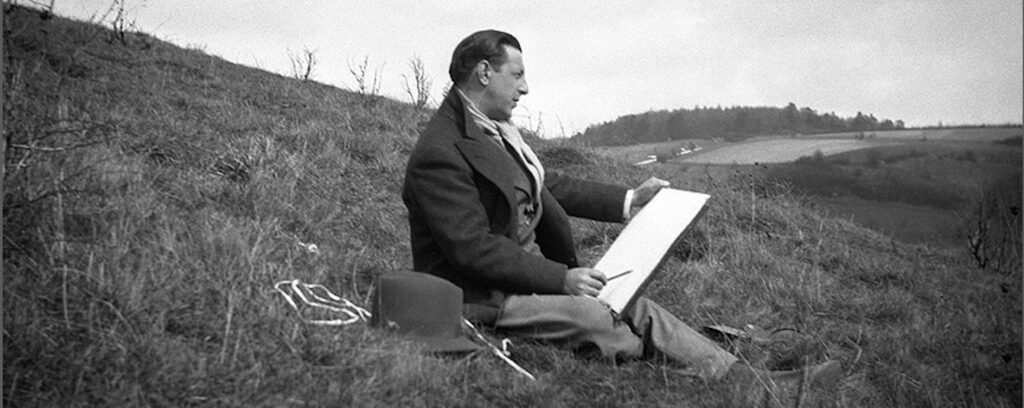
Paul has work in many permanent art collections, including the National Art Collections Fund, and was elected to the Royal West of England Academy in 2000. His broadcast work includes the award winning ITV documentary Redundant Warrior about photojournalist Don McCullin and with more than 80 academic papers and nine books to his name, including several on the British artist Stanley Spencer and a study of the work of John and Paul Nash, this year he launched a website dedicated to Paul Nash (pictured above) in Dorset.
‘Nash painted over 80 works in Dorset, and took hundreds of memorable photographs, during long visits to the Isle of Purbeck. In the thirties he began drawing on Ballard Head, then through 1935 and 1936 he re-imagined Swanage with a Surrealist’s eye, creating some of the century’s most remarkable paintings.’
In July 1946 and in poor health Nash came to stay at the Florida Hotel in Boscombe, since renamed Victory Villas, from where he could see the broad sweep of Poole Bay from Hengistbury Head to Old Harry Rocks. He mentioned working on a watercolour in a letter written to his brother John on 10 July. That night he died in his sleep.
Gathered together in one place, it’s startling to see the breadth of work Nash made in Dorset. Consider also his famous Shell Guide to Dorset published in 1937, the many photographs he took, his wife Margaret’s writing and the pioneering work of his some-time lover Eileen Agar, and the connection of talent, time and place has more than made its mark on 20th century British art.
‘Pennie Denton made a fine study of this in her book Seaside Surrealism revealing how Nash marvelled at the strangeness of Swanage, cobbled together by John Mowlem from architectural remnants of the City of London he worked on. There are lots of examples of it in Nash’s work, but Event on the Downs with its runaway tennis ball and tree stump is very peculiar. His paintings are enchanting, but there are deep personal shadows too; they are quite sombre – he was obsessed by mortality.’
Having written a book about the work of the mysterious Banksy, Paul is a regular media commentator on the graffiti artist’s exploits and last year a film on clips-based social media platform TikTok claimed he was, in fact, Bansky. It went viral with more than two million views… much to Paul’s amusement.

‘That was very funny,’ he laughs. ‘I’m usually called an ‘expert’ or a ‘highbrow’, though never by me, but I’ve studied Banksy’s work so I’m often asked to comment on artwork that people are hoping is by him – I’ll say him but is could be her or they, of course.
‘Every discovery of a new work follows the same pattern. First, the media ask: ‘is it or isn’t it?’ Then if Banksy reveals it’s a real piece, you have a wave of collective ownership – a gift to the community – as queues form to see it and selfies are taken. Sadly, that is usually followed by a violation when the work is painted over, or the piece is sold to a private collector – from public wall to paywall. Neighbourhoods, towns, in fact whole countries, as in Ukraine recently, express a profound sense of loss.’
At least three, possibly four, Banksy pieces have graced Dorset surfaces. In 2003 the words ‘Buried Treasure’ were painted on Bournemouth Pier and a nearby groyne, a work that was later featured in Banksy’s book Existencilism. The piece on the Pier was removed and it’s thought the words on the groyne gradually faded from sight.
Then, in 2012 Banksy painted an origami crane holding a goldfish on the side of a garage at Gosling’s Bridge in Lyme Regis. It too has since faded from view.
‘That was a very fine example of the stenciller’s craft and technical dexterity,’ says Paul. ‘I was fascinated to see the quality of the work, especially the exquisite rendering of the dangling goldfish.’
Last year, a version of the famous Girl With Balloon appeared in Bournemouth’s Lorne Park Road. Paul was far from convinced by the artwork except that it was quickly defaced by Banksy’s long-standing street art rivals Team Robbo.
‘They go to great lengths to desecrate Banksy’s work, so I have to ask myself why they bothered with this one unless they knew it was actually by Banksy.’
The final Dorset link to Banksy is a piece that featured in his notorious shop GDP (“where art irritates life”) – a tombstone engraved “You have now reached your final destination” made in Portland Stone.
If its mordant message reverberates with Paul Nash’s bleaker compulsions, it is perhaps easier to find Banksy’s outsider status echoed in that of Gilbert Spencer, the noted landscape artist with a penchant for Dorset and the subject of Paul Gough’s forthcoming book.
‘Banksy is a renegade and especially as he gets older his work has a purpose – social commentary still with a hint of frivolity, but asking questions. This is public art with a point and in it he has succeeded in stimulating an on-going discussion about art.
‘I think he would recognise something of himself in Spencer. I’m 80,000 words into my book about Gilbert and am developing this idea of the affinity he felt with the countryman, they way he could navigate his way home in the dark and his natural feel for space.’
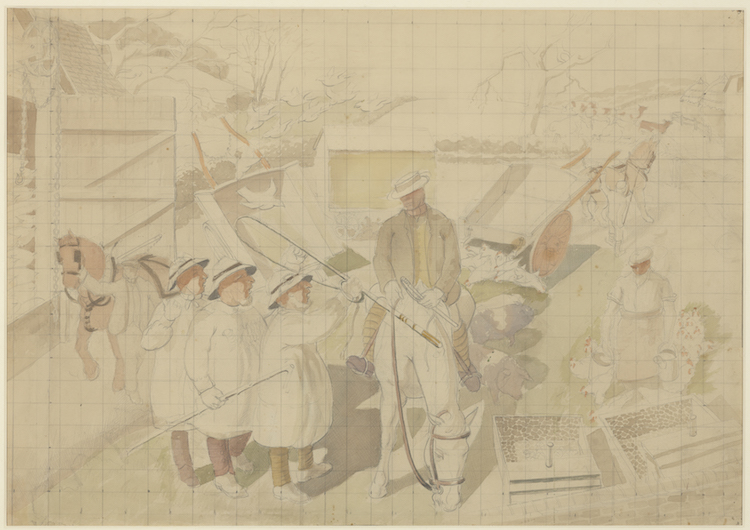
In 1920, the artist Henry Lamb invited Gilbert and his brother Stanley to join him on a painting trip to Stourpaine. It wasn’t to Stanley’s taste, but Gilbert fell in love with the landscape and returned many times over the course of his life – he died in 1979 – to paint subjects throughout the Blackmore Vale and further afield.
‘His landscapes are beautiful, but many of them appear accidental,’ explains Paul. ‘You won’t find any of the obvious subjects – Lulworth or Corfe Castle for instance – he painted allotments, views from windows, rolling landscapes. He identified very closely with the plight of the rural poor and particularly connected with the story of the Tolpuddle Martyrs.’
Indeed, Gilbert’s watercolour The Beginning of an Event in History: The Tolpuddle Martyrs was made in the mid-1930s for a mural that was never painted, but it was a subject he returned to time and again. As late as 1964 the same group of farm labourers approaching a man on horseback appear in his painting The Progress of Husbandry depicting the history of farming.
This theme of reaching into the past to shape a future continues far beyond the art world and Paul says one of the great joys of his stewardship of AUB is the commitment it is now making to Dorset off campus. It is reopening Bournemouth’s art deco Palace Court Theatre and taking its work into the reinvigorated Bobby’s department store in the Square as well as the more modern Avenue shopping centre. It is also fostering closer links with cultural organisations including Dorset Museum, Lighthouse Poole, the Russell-Cotes Museum, Pavilion Dance South West, Poole Museum and Bournemouth Symphony Orchestra.
‘We’re one of three universities in Bournemouth and we talk all the time about ways to make the most of the talent and enthusiasm that is attracted to the Dorset area and the impact that can make in terms of creativity as well as the local economy.
‘There is such a lot of creative activity going on.’
• First published in Dorset Life.