It’s the finest Thomas Hardy archive in the world, a treasure trove of manuscripts, correspondence, photographs and ephemera that speak not only of his literary life, but also shed light on the man behind the formidable reputation.
Or so it is believed.
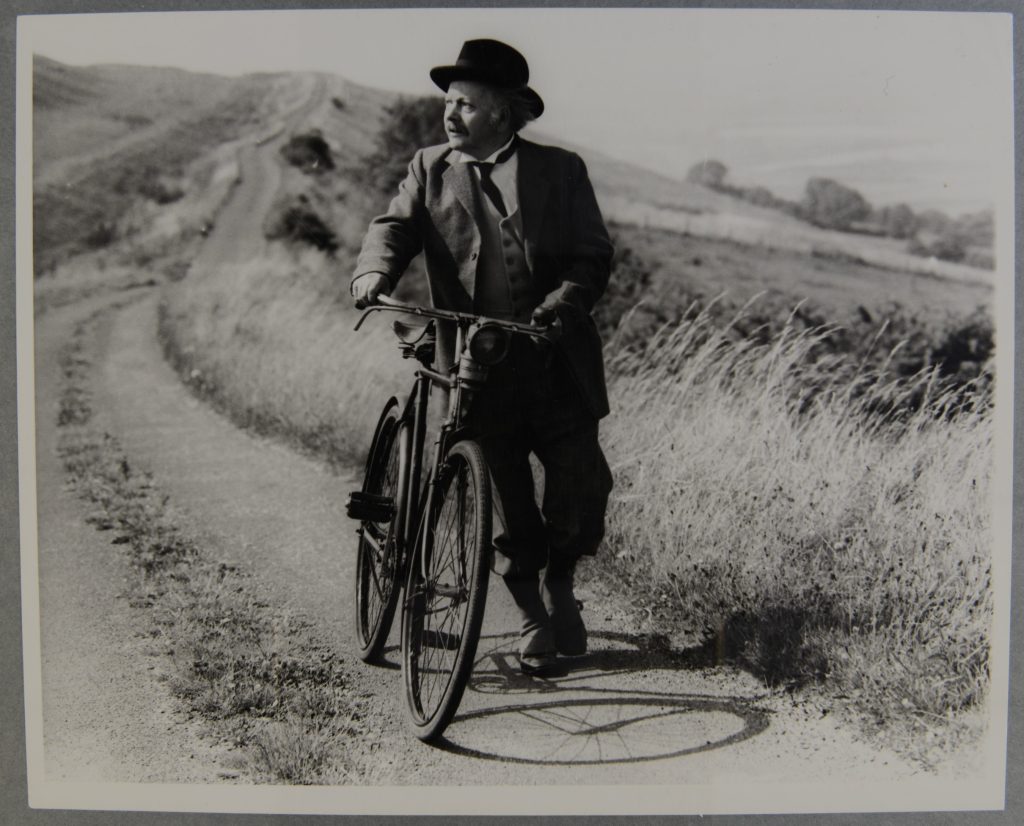
For although the Thomas Hardy Archive is inscribed by UNESCO as part of its Memory of the World programme, placing it on a par with the Domesday Book, the Magna Carta, the Mappa Mundi, and comparable archives of Shakespeare Documents and George Orwell, its precise contents have remained tantalising just out of reach.
Until now.
Gifted to Dorset Museum by the Hardy family in 1937, the collection transferred on deposit to Dorset History Centre in 2020 where it is contained in 150 boxes that also house some more recent acquisitions, but its full extent is only just starting to be realised, described in detail and made fully accessible to the public.
Thanks to an offer of support from the National Trust, Dorset History Centre and its support charity Dorset Archives Trust, working closely with the Thomas Hardy Society, has reached its fundraising target of £68,000 that will see an archivist employed for 18 months to survey the content and oversee its careful cataloguing.
“For us, in terms of archives, this is really the crown jewels,” says Sam Johnston, Service Manager for Archives and Records at Dorset History Centre.
“Thomas Hardy is a world figure so to have his pre-eminent archive in Dorchester, the town at the heart of so much of his work, is incredibly important. Who knows what treasures will be found when we get into it?
“Cataloguing is unglamorous, but it has huge long-term benefits. You have to know what you’ve got, so as well as making it fully accessible, the Hardy Archive Project also protects it for the future.”
By way of illustration Sam points to the recent scandal at the British Museum where, following the theft of some 2,000 items, it emerged 2.4 million items remain un-catalogued or partially catalogued. The point is further made by the welcome upsurge in requests from members of the public to view material at Dorset History Centre following the cataloguing in recent years of the Dame Elisabeth Frink, Bankes Family and Herrison Hospital archives.
Known highlights of the Hardy Archive include handwritten manuscripts of The Mayor of Casterbridge, Under the Greenwood Tree and The Return of the Native; some 4,000 letters and items of correspondence; scores of photographs and all manner of personal documents and keepsakes including Hardy’s hymn sheet from his father’s funeral at Stinsford Church in 1892, a Christmas card to a member of staff and the plans to Max Gate – the house he designed and built in Dorchester in 1885 and lived in until his death in 1928.
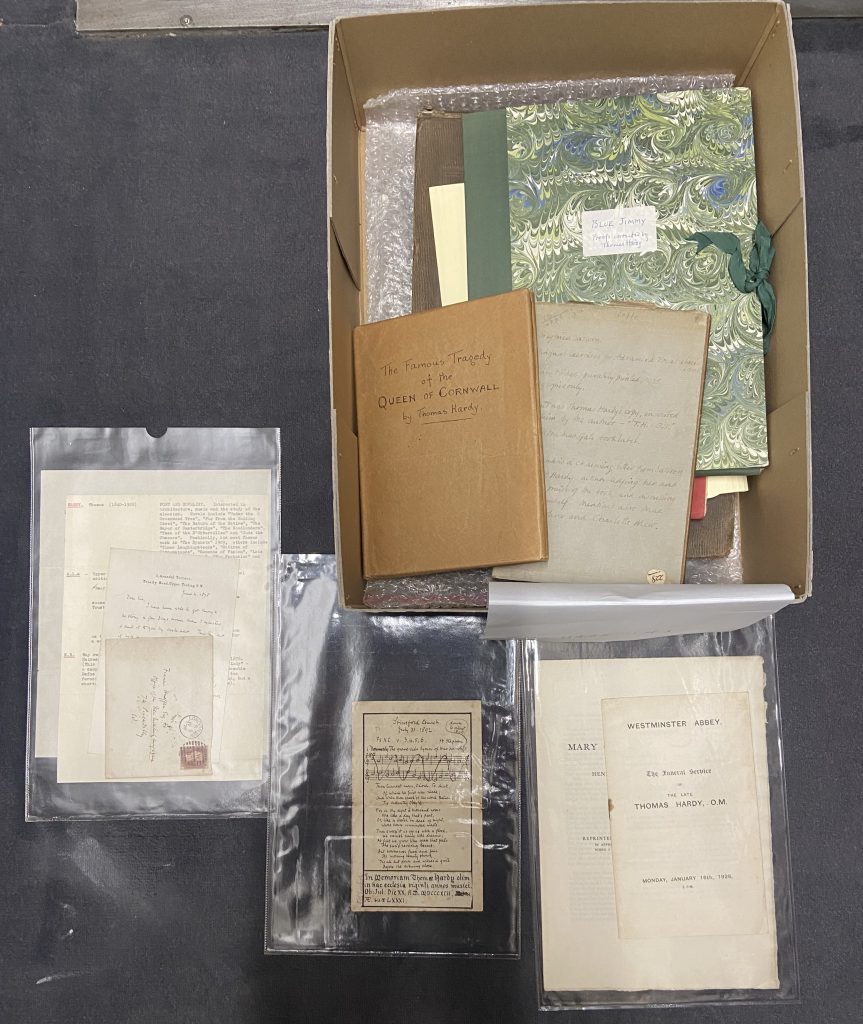
“The manuscripts show Hardy at work in full flow,” says Sam. “They are handwritten draft copies of the novels with scorings, annotations and changes offering a rare insight into the writer honing his work.
“Ironically, the manuscript novels are the most immediately accessible part of the Archive in that two are on display in the Hardy Gallery at the Dorset Museum and digitised versions can also be accessed for research purposes.”
The sizable collection of images includes Hardy’s friend the photographer Hermann Lea’s proofs for his project documenting the locales from Hardy’s novels. The writer is known to have advised Lea on camera angles and perspective as well as subject matter for his books A Handbook to the Wessex Country (1905) and Thomas Hardy’s Wessex (1913) so to see proof prints that didn’t appear in the books adds a new layer to the history.
Other photos include several of Hardy in domestic settings at Max Gate and elsewhere, and a collection of theatrical subjects showing actors on stage, possibly in productions of his work by the Hardy Players. Along with the relics from Hardy’s daily life, these are the most intimate items in the Archive.
“For me, it is these small vignettes of everyday life that really draw out the story of the man and this is exactly what we’re hoping to be able to do more of as we come to understand its contents,” adds Sam.
“Dorset has taken great strides in making the most of Hardy in terms of tourism and commerce – the concept of Thomas Hardy Country and the Hardy Trail are just two examples – and we fully support that. The Thomas Hardy Archive is part of that story as well, an internationally important collection held within a couple of miles of where one of this country’s most celebrated writers was born and died.
“It is a major asset to Dorset and yet until it is catalogued it remains inaccessible to the people of Dorset and beyond.”
The Archive promises to be an invaluable resource for the curious, the studious, the creative and the industrious. Whether academics visiting for the Hardy Society’s annual Thomas Hardy International Conference and Festival, students researching essays, or readers who have enjoyed his books and want to know more about the man behind the words, understanding the Hardy Archive should reveal more about his inner life.
Outside of his work, Hardy was a prolific letter writer and some of what occupied his mind is likely to be found in correspondence that includes letters from his near neighbour TE Lawrence, fellow writers JM Barrie and Evelyn Waugh, the Powys brothers – TF, Llewelyn and John Cowper, all associated with Chaldon Herring – the poet Siegfried Sassoon and composer Gustav Holst.
“Hardy enjoyed a high profile in his day and concerned himself with a range of issues including animals rights and universal suffrage, but he was also very plugged into Dorchester life and had this relationship with the wider Dorset area. For instance, he served as a magistrate and during World War 1 was known to be quite hard line on instances of hoarding and overcharging that came before the court.”
The Archive extends just beyond Hardy’s lifetime containing correspondence in the wake of his death between the Dean of Westminster and the Vicar of Fordington, Rev Richard Grosvenor Bartelot in which the Dean reveals that his decision to permit Hardy’s ashes to be buried in Poets’ Corner had created controversy with some who questioned Hardy’s morality and claimed he not a Christian. In reply, Rev Bartelot offered some reassurance of the writer’s essential Christianity although conceded he refused to be drawn on religious matters.
In the event, on 16 January 1928 (five days after his death) Hardy’s ashes were buried in Westminster Abbey, close to the grave of Charles Dickens, in a casket sprinkled with Dorset soil.
Photos: The Hardy Archive at Dorset History Centre
What can I do to help?
The Thomas Hardy Archive Project has achieved its initial aim but the fundraising continues to enable this internationally important collection to be made more accessible with public engagement projects and more extensive digitisation.
To donate, visit the Dorset Archives Trust website and click the DONATE button.
Beyond that, visit the Dorset History Centre website and sign up for its e-newsletter. Once the archivist is in post the newsletter will feature regular updates from the Hardy Archive as it gives up its secrets.
Volunteer. The Hardy Archive Project is going to need volunteers to help catalogue and describe its contents – what better way to get close to vital pieces of history and play a part in recording them for posterity?
https://www.dorsetarchivestrust.org
https://www.dorsetcouncil.gov.uk/libraries-history-culture/dorset-history-centre
First published in Dorset magazine