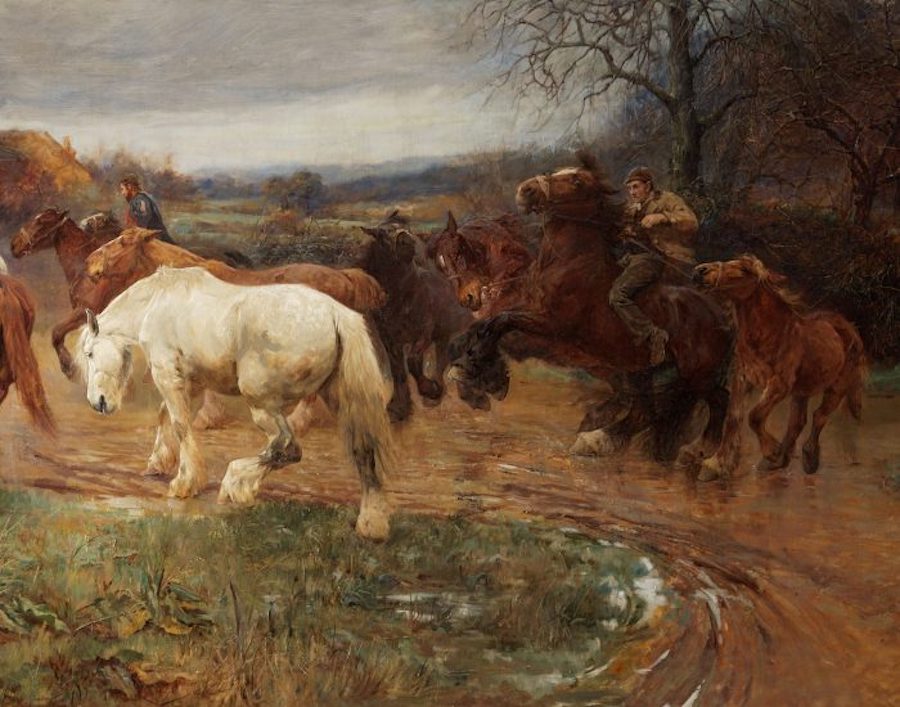
Bournemouth’s Russell-Cotes Gallery is hosting a major new exhibition of work by Lucy Kemp-Welch – the first for more than twenty years – in the town where the esteemed equestrian painter was born in 1869.
The exhibition, In Her Own Voice: The Art of Lucy Kemp-Welch (1869-1958), is curated by art historian David Boyd Haycock whose new biography of Kemp-Welch is to be published this year and, having fallen out of fashion in the years after World War 2, is the latest step in the slow climb back to prominence for an artist who exhibited 61 paintings in the prestigious Royal Academy of Arts Summer Exhibition from 1895 to her final submission in 1949.
‘It has been a real pleasure to gather these works by an artist who really should be much better known than she is; I only wish we could have got more,’ says David.
‘In her day she was more highly regarded than her friend Alfred Munnings who looked up to her and it’s not difficult to imagine that had she been a man she would have been commissioned as a war artist to go to France as Munnings did.’
Undeterred and keen to ‘do her bit’, Lucy made her way to Wiltshire where she befriended an Army officer, painted his horse and secured a commission to paint the Royal Horse Artillery on exercise on Salisbury Plain in another of the vast, outsized canvasses for which she is best known.
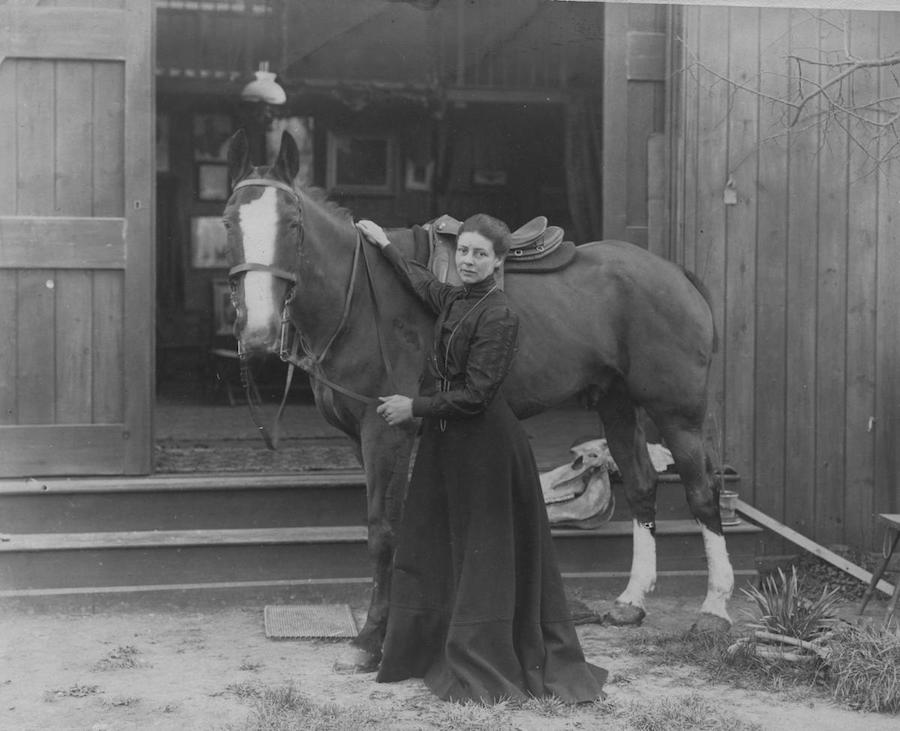
‘That’s very typical of her spirit,’ says David. ‘She was barely five feet tall, yet she was confident, strong willed and had a way of getting people to do things for her. She used to set up her enormous canvasses outdoors and leave them there for weeks at a time with a framework around them to protect them, then somehow have them boxed up and moved to where she wanted them.’
Lucy was born in Bournemouth, the eldest daughter of solicitor Edwin Kemp-Welch whose father Martin was a notable benefactor of the neighbouring town of Poole where he paid for two schools to be set up and co-founded the town’s Gas Company that was largely responsible for providing its water supply. Kemp-Welch School, now St Aldhelm’s Academy, on Herbert Avenue was named in his memory when it opened in 1938.
Edwin was quite happy that Lucy and her sister Edith could draw well, but he resisted their mother’s request for them to have further lessons. That they both ended up as professional, exhibiting artists living with their cousin Margaret – also an artist – says much about their determination to do things their way. Both moved to Bushey in Hertfordshire to study at artist Hubert von Herkomer’s art school that Lucy subsequently took over and where she was still a student in 1895 when her painting Gypsy Drovers Taking Horses was shown at the Royal Academy. Two years later her painting Colt-Hunting in the New Forest was also accepted, exponentially enhancing her reputation and being reported in newspapers around the world.
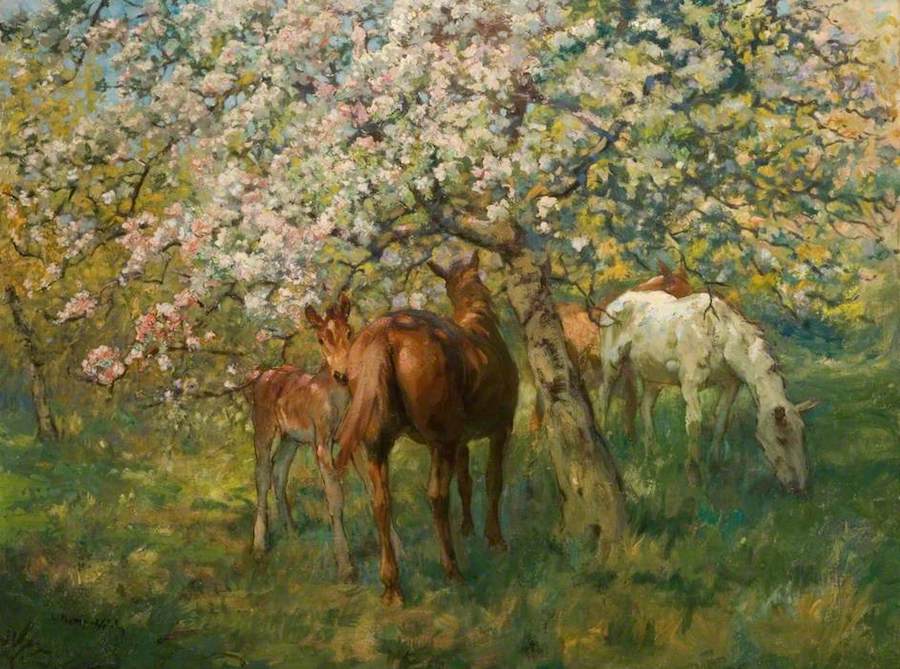
‘Typically, Lucy insisted on riding the horses when she made Colt-Hunting in the New Forest,’ says David. ‘She had to immerse herself first hand in the scenes she painted, for instance leading a team of heavy working horses hauling tree trunks out of the New Forest. She had her own horses and she cycled, then later when she started painting circus scenes in the 1920s and 30s she got a car and followed the circus all over the country.’
In 1902, Lucy Kemp-Welch and Louise Jopling became the first women to be admitted to the Royal Society of British Artists and while it’s tempting to view Lucy at the vanguard of the struggle for women’s rights – in 1924 her mural Women’s Work in the Great War 1914-1918 was unveiled by Princess Mary at the Royal Exchange – as early as 1908 she signed the first circular distributed by the National Women’s Anti-Suffrage Association.
Conversely, when two of her paintings were selected to appear in the Victorian Era Exhibition as part of Queen Victoria’s Diamond Jubilee celebrations in 1897 she bemoaned the segregation of male and female artists, then a year later exhibited to great acclaim with the Society of Lady Artists.
‘There are certainly contradictions and it’s difficult to pin down her political position. Reading interviews with her she comes across as very modest, but it’s certain she didn’t view her gender as a barrier to what she wanted to do and she clearly wanted to be recognised as an artist on her own terms.
‘Having said that it’s likely that her reputation may have proven more robust had she been a man, which is why the work of David Messum who has represented her estate since the 1970s has to be acknowledged. When fashions change against artists it can be a long way back and although there have always been pockets of interest, often linked to her famous illustrations for the novel Black Beauty, she has certainly benefited from the renewed efforts to rediscover female artists.’
That the exhibition is being hosted at the Russell-Cotes feels entirely appropriate, says manager Sarah Newman: ‘We know that our founder, Merton Russell-Cotes, was a keen admirer of the artist and an advocate for female artists. He owned two of her works and in his autobiography, described how she ‘sprang up in a phenomenal way… making her mark instantly.’ The museum has subsequently acquired five more of her works, and we have several letters written between Kemp-Welch and the museum’s curators in our archive.’
Several works from private collections are on view to the public for the first time and a programme of events, activities and tours complements the exhibition, which runs until 1 October.
www.russellcotes.com
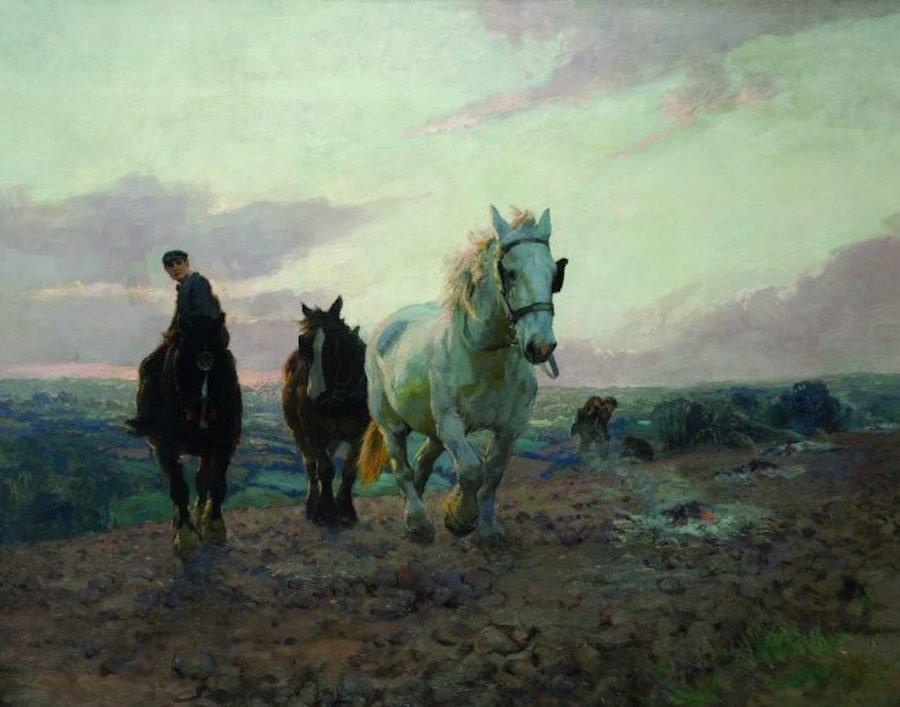
In Her Own Voice: The Art of Lucy Kemp-Welch (1869-1958 is a collaborative exhibition between Russell-Cotes Art Gallery and Museum and the National Horse Racing Museum, Newmarket. Significant loans from public collections include: Imperial War Museum, Bushey Museum and Art Gallery, Lucy Kemp-Welch Memorial Trust, Leamington Spa Museum, Southampton City Art Gallery and The Worshipful Company of Mercers. The loans are supported by the Weston Loan Programme with Art Fund, the first UK-wide funding scheme to enable smaller and local authority museums to borrow works of art and artefacts from national collections.
Images: © David Messum Fine Art Ltd. Courtesy of Bushey Museum and Art Gallery
• First published in Dorset Life.