Blessed with a voice that can move – and an imagination to match – Douglas Dare returns to his native Dorset this summer having composed the soundtrack for Consequences, Radical Ritual’s monumental new art installation that will be unveiled next to the famous Cerne Abbas Giant then visit hillsides in South Somerset and the Isle of Purbeck as part of Inside Out Dorset.
Having grown up on a West Dorset dairy farm dreaming of city life, he studied at the Liverpool Institute for Performing Arts, where he sang with Paul McCartney in a private session, and has gone on to make four albums of piano-led music that links Western classical, chamber pop, folk traditions and the avant-garde. Highlights include 2020’s Milkteeth, which documents his experiences growing up Queer in the countryside, and last year’s Omni in which he embraced electronica while inhabiting different characters across its tracks.
This year, as well as playing a rare home town show at Bridport Arts Centre, he has performed solo at the Royal Albert Hall for a Teenage Cancer Trust benefit headlined by the legendary Penguin Café.
In this exclusive interview, Douglas talks about the joy of mining his Dorset roots for inspiration to create a soundtrack that compliments such an extraordinary art intervention in the landscape he knows so well.
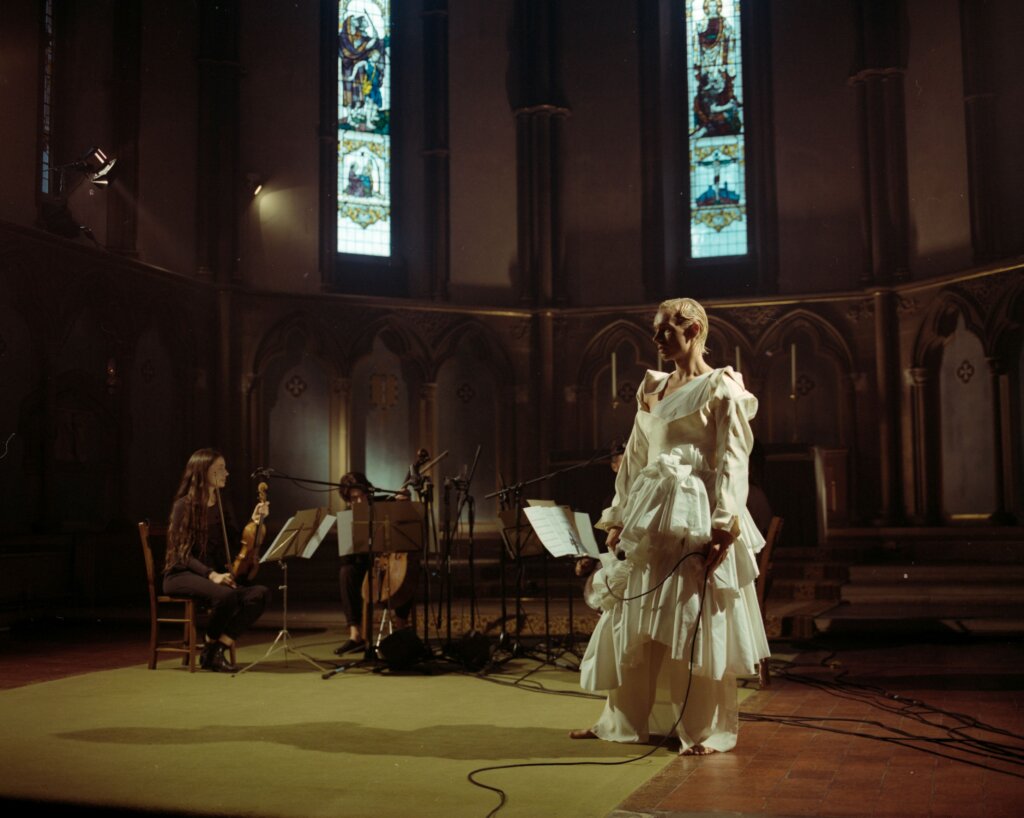
How did you get involved in the project?
I was approached by [artist] Emily Manning, who is working on the project, after someone at Radical Ritual who had seen me perform suggested me as composer for the project because they knew I was from Dorset. My full-time thing is a songwriter – I release albums and I tour. I’ve done bits and pieces of composition for dance and TV and film, some commercials, but I want to do more. So it was very serendipitous that it worked out for me because I’m in between albums at the moment, I’m writing a new one.
So, they got in touch and asked if I was interested in doing this and it was perfect for me. I grew up around the corner from the Cerne Abbas Giant and saw it regularly when I was a kid.
How did you approach the work?
Earlier in the year, we did a little residential with six or seven different people involved in the project. So, Emily was there as she’s sort of curating it, and then we had someone who was working with the history element, we had someone who was working with the actual design element, and so on, and we actually created a game of consequences ourselves. This group of us just spoke all day and night about the project, and what it meant to us, and the giant and the folklore behind it. We just absorbed all these different perspectives on the subject then went away to do our separate things.
Whilst I was there I was making some field recordings so I had chalk from the Cerne Abbas Giant and recorded the sound of it being ground it up. We were using different materials, branches and different berries and boiling them down to make inks, and I was recording the sound just to sort of get these real elements of the landscape.
So that was a really great starting point and although it was a very open-ended brief in terms of the composition, sort of do what you want, obviously I think we’re all very much on the same page in terms of what we wanted to do.
And how has it developed from there?
Since then I’ve been sending different drafts of the composition and getting feedback and we’re also recording members of the different groups that are reading the poem that has been written for the project [‘This Patch of Land’, by Dorset National Landscape commissioned writer Louisa Adjoa Parker] and then I’m incorporating that into the composition. So it’s not just my music and my voice, but the voices of the people that are involved as well.
The plan was that it would be 15 minutes of music that would loop so it could be played continuously and feel continuous and sort of unending. It’s not a song, it’s a mixture of field recordings and ambient sounds with song elements, poetry, spoken word, and the textures that kind of convey this journey throughout the piece.
Piano is my lead instrument, but I’m using clarinets and horns because they have this earthy texture that almost sounds ancient. Initially I didn’t put much of my own voice in it, but I’ve been asked to include more so I’ve incorporated more singing.
It sounds like you’re really pushing your own writing and playing in new directions?
Absolutely, yeah. Actually though, I was learning the clarinet when I was maybe 12 years old and then I basically put it down for a long time because I didn’t think it was very cool! I went off to study music in Liverpool, got in lots of bands – rock and pop, indie, folk and did all that – and then with my own albums, I’ve progressed through different styles and my last album was electronic.
This year I was asked to do a solo show at the Royal Albert Hall and with such an opportunity I felt I needed to add something to my set that felt fresh and new and different. And so I thought: ‘Hey, I’ll get a clarinet and see if I’ve still got it!’.
So, I performed and played the clarinet on the Royal Albert Hall stage. I know, a baptism of fire, yeah! I was layering the clarinet using a loop effect and it went so well that when it came to doing this project I thought I had to use clarinet. Actually, now I’ve been working on this composition and writing a new album, which I’m incorporating clarinet into as well, I’m thinking about spoken word more and how it’s directly influencing what I’m working on as well.
You’ve spoken about how Dorset gave you something to leave behind when you started your career; is it now offering something to come back to as well?
Yeah, it’s been nice to get into the real earthy sounds and to be thinking about ancient music and why we have song. Song is about communicating a message and you need melodies that could be communicated from person to person, not written down. It’s like an oral history and I love thinking about melodies and harmonies that feel timeless.
I’m reading the poetry and, as you can hear, I speak really RP, but my family speak with a really strong Dorset accent. My dad’s a farmer and he holds on to that Dorset dialect, but as I’m reading the poetry in this piece I find I’m leaning into my West Dorset accent and embracing that side – for the first time really. I’m not putting it on, I’m just accessing it.
Fascinating. It’s impossible to ignore your fellow native Dorset artist, PJ Harvey…
Yeah, well PJ Harvey has always been a big influence on me, musically. Not only am I a big fan but coincidentally her family’s farm was the farm up the road from our farm and our families knew each other. So, when I was younger Polly [Harvey] was just the woman who lived up the road and we’d see her in town [Bridport]. When I heard my parents saying that Polly was playing Glastonbury, as a child that didn’t mean anything to me, but as I grew up and started to discover music for myself, I fell in love with what she did as PJ Harvey – everything from the heavy rock music, to her later involvement into folk music and traditional songs and documentary-style music going to war-torn countries and all these different things. That really inspired me.
Just last year she published a book of poetry written in the Dorset dialect so she really embraces where she’s from. She even has an album called White Chalk, of course. So, my biggest idol happens to be from the place where I’m from.
I haven’t tapped into that very much to this point – although I have an album called Milkteeth that was talking about my childhood growing up in West Dorset, my personal experience growing up there as a Queer person, rather than necessarily being the land itself. So it’s interesting to delve into this project and think more about the actual history of the place rather than my own personal experience.
Is it fair to say you sound more at ease with Dorset these days?
I think as any artist, or any creative person, you need initially to leave where you’re from; you need to leave your upbringing to find your own path and explore what and who you are. It makes sense.
But the world over people get older and end up returning to where they’re from, don’t they? It can be very hard to come back though. I live in East London and for many years thought I would never go back to Dorset to live, but every time I come back it starts to feel a bit more appealing.
And this time you’re bringing a new giant for Dorset with you – that’s pretty bold!
I think it’s a beautiful thing to create new folklore. It’s all very well celebrating what has come before, but to create a new legend or to create new stories that are by people of today, I think that’s really special. And obviously this giant isn’t going to remain next to the Cerna Giant it’s going to move around. I don’t know whether they ever hope for it to have some kind of permanent home. I’m not sure if that’s even possible because of the sheer size of it – it’s going to be about the same size as Cerne Giant – but if nothing else, it’s going to be a real spectacle.
I’m thinking about that when I’m composing my music, that it has some element of grandeur and the music has some epic moments, but also some very intimate and tender moments. What’s very interesting for me is imagining how the music will be listened and how it will be perceived in the physical space. I think it’s going to be played on these big speakers. At the moment, I can’t quite imagine how that’s going to be, but we will find out more as we go along.
What I do really like about it is that even though I’m incorporating field recordings like the chalk and I have footsteps going through mud and things like this, but as soon as you have it outside you have the natural elements within in that present moment that will add to the composition. There could be bird song, wind through the trees, people chatting, whatever it might be. It’s a living, breathing, changing composition in the moment.
This feels very unique.