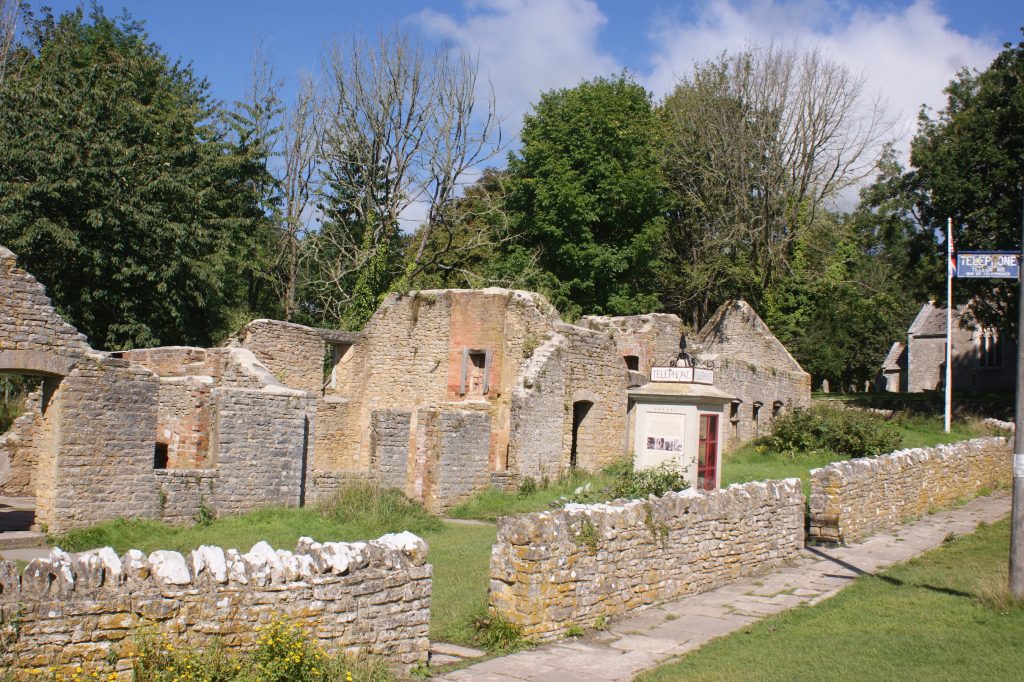
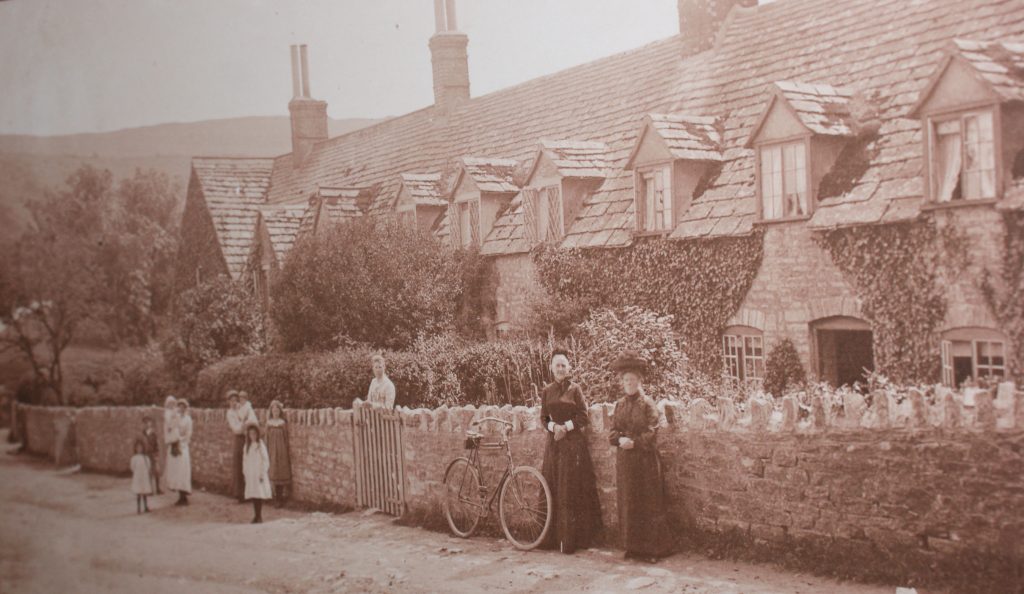
Dorset has no shortage of places to arouse the inner poet, but few hit the spot quite like Tyneham with its effortless ability to lure the inspired into paroxysms of bucolic fantasy. Occupying an apparently idyllic spot between Lulworth and Kimmeridge, a mile from what is now called the Jurassic Coast, many describe as ‘lost’, ‘forgotten’ or ‘secret”, but it’s none of those. Nor is it ‘The Village That Died For England’ as the title of Patrick Wright otherwise authoritative 1995 (updated 2021) book declared.
To paraphrase the estimable Lynda Price who spent the best part of 15 years tirelessly enhancing, preserving and interpreting what remains of the village, Tyneham has evolved in different and unfamiliar ways to once similar Purbeck villages. It is an enigma, a unique viewpoint from which to peer into a past that is now just beyond living memory.
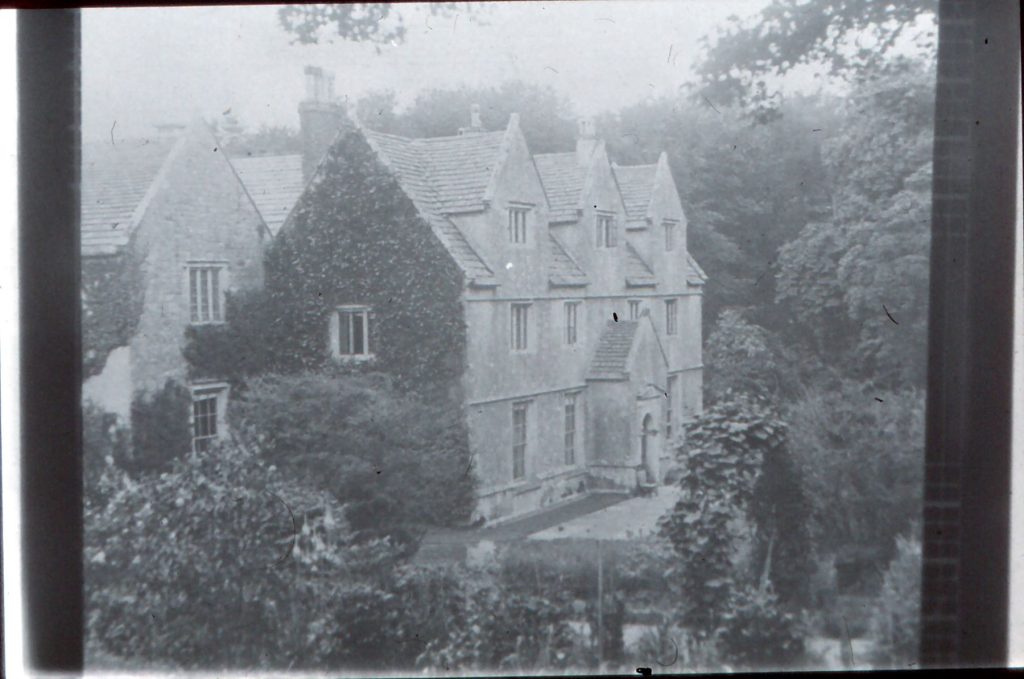
Eighty years ago, on 19 December 1943 the last of its 225 residents including those of neighbouring Povington and Worbarrow, the surrounding farms, and the Elizabethan Tyneham House – home to the aristocratic Bond family for 260 years – left for the final time. Requisitioned to train troops in the build up to D-Day, Tyneham Valley has been retained as part of Lulworth gunnery range ever since, its residents unable to return.
They’d been given a month’s notice and by the time Tyneham’s own D-Day arrived that cold December morning, many had already set up home inland, often in newly built council houses with running water, electricity and indoor bathrooms. Nonetheless, as the final few departed one pinned a note to the door of St Mary’s Church. It read: “Please treat the church and houses with care. We have given up our homes, where many of us have lived for generations, to help win the war to keep men free. We shall return one day and thank you for treating the village kindly.”
And there hangs the conundrum. Depending on who tells Tyneham’s tale, to some those 7,500 acres have come to symbolise the State riding rough shod over the individual; to others they contain the final resting place of feudal England; or the crucible of the Cold War consensus; or even a monument to laissez-faire environmental management.
A campaign spearheaded by the Tyneham Action Group in the late 1960s to restore the village to the people that once lived there took its cause to Parliament, but ultimately had to settle for greater public access and since the 1970s the Army has opened range walks and maintained what remains of Tyneham’s buildings, although not Tyneham House, which remained out of bounds, was then dismantled and finally demolished.
Today, as the former residents who wanted to be there lie at rest in the churchyard, Tyneham continues to inspire innumerable social media posts apparently longing to see it resettled. But by whom? The village is a mass of contradictions, begging questions that can no longer be answered; at least not by the people who lived the final chapters of its inhabited history.
Some 35 years ago, as a student journalist, I went in search of that story in the company of three former residents, the last of those who lived there.
Let me introduce you to them…

Fred Knight was born in Museum Cottage but had to leave Tyneham after his father Frederick, the last coachman at Tyneham House, was displaced by a motor car. Fred died in 1994, but his wonderfully evocative memoir, Tyneham Boyhood: The Rooks That Lived in the Elm Trees, published the same year, can still be found if you hunt hard enough.
Helen Taylor’s family lived in Laundry Cottage and did the washing for Tyneham House where she went to work as a seamstress. Bessie to those who knew her, Miss Taylor to the rest of us, she was one of the last to leave Tyneham, aged 42. She died in 1999, but many of her stories found their way into Dr Andrew Norman’s excellent 2007 book, Tyneham: A Tribute.
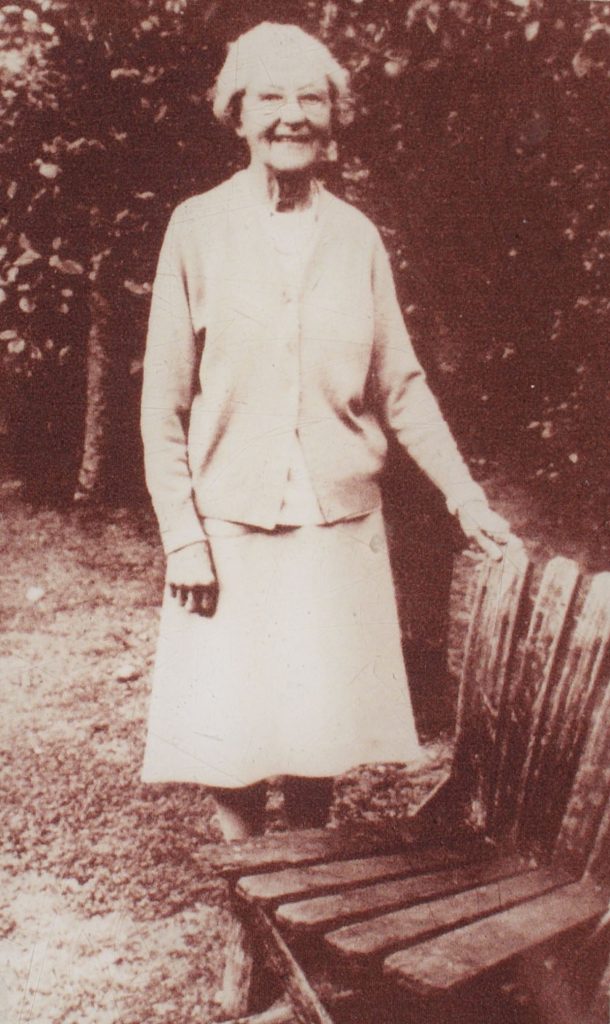
Arthur Grant was the son of the estate woodman and lived in Gwyle Cottage. He worked as a pantry boy at Tyneham House after the Bonds leased it to a South African doctor called Hans Sauer whose wife recommended Arthur to her brother, a merchant navy captain, and he joined the Union-Castle Line. Having enjoyed a second career as a photographer with a studio in Wareham, Arthur died in 2010.
In an effort to invoke the Tyneham they knew as children, Fred and Arthur guided me around the village. Fred even secured access for one last look at his boyhood home and Tyneham House.
:: The Evacuation
Tyneham was in decline long before its residents were told to leave. The village school had been closed for ten years as there were no children of school age. There were few opportunities for employment other than at Tyneham House. The tenant farmer had not long replaced most of his labourers with a tractor; no sheep had been kept locally for two years so there was no need for a shepherd; and the only fishermen still living at Worbarrow were in their eighties and nineties, too old to row a boat. Even the local rector, who was already in the Army, had left two years previously.
“Well, I mean everybody had to go, though of course, they told us we could go back,” Helen Taylor told me. “Mrs Bond was very good with organising everything and got people in their homes as far as she could. We left fowl-houses and all that at Tyneham, thinking they’d be there when we got back. We were hoping to go back, but there it was, they decided to keep it.”
By then, Fred and Arthur had both had left the village and found a wider world far beyond its confines.
“Nobody wanted to come back,” said Fred.
“It was my early childhood, I didn’t know anything any different, but if I could have seen into the future I would have thought a lot more about it.
Why is it such a terrific number of people come here and have a look around? ‘Tis because of what happened to Tyneham. It’s been evacuated and now ’tis a forgotten village. Well, it’s not forgotten, we have an awful lot of people get an awful lot of pleasure coming to see this now.”
Arthur heard about the evacuation when on shore leave.
“My parents had moved just before the evacuation, but I took it in my stride,” he remembered. “Being young I didn’t worry too much about it. I was happy when I went off to sea and saw all these mod cons, but it’s funny, in the latter years that I became very attached. Driving down this morning, it was rather upsetting really.”
:: Village life
It’s easy to view Tyneham romantically as some kind of Arcadia, but life there was very different to what we know today. In some respects it had remained unchanged for centuries with jobs and housing largely dependent on the landowner, low wages and few opportunities. Entertainment was homemade, as was a lot of the food and clothing, although most had most of what they needed and nearly all wanted for less than they would today. Village thrift clubs, for major expenses such as new boots or coal, were augmented by the charitable efforts of the Bonds and at Christmas the children were invited to tea at Tyneham House with presents around the tree.
“We had concerts in the school in the wintertime, and dances, and whist drives and the [Creech] Grange people, the Povington people, and from Kimmeridge would all come over. They used to do the old time dancing. The old chaps would get up for the polka because it was only two scuffs here and two scuffs there,” said Helen Taylor who recalled her brother Bill (one of three killed in the First World War) playing the melodeon and teaching local lads to dance in the Laundry Cottage kitchen.
“And my mother said: ‘Look, they must bring their slippers, I’m not having them wearing out my lino.’ So then they had to bring up their slippers, these farm lads!”
Bill Taylor had left Tyneham in search of work and, accelerated by the dreadful War, over the next twenty years many others did likewise, including Fred Knight’s family, first to Povington and then to Wareham: “When I left school I got a job with a master plumber and we used to do plumbing in various country houses and Tyneham House was one of those. I even had the job to ride a bicycle from Wareham to Tyneham to put a washer on the village tap once. That was always a big joke.”
Slightly younger, Arthur also felt the pull of the modern world.
“The life of the village revolved around the church and everyone was expected to go. Sunday School as well,” he said. “Of course, everyone looked up to the lord of the manor and then the rector, you had terrific respect for the clergy. There was no police; the nearest policeman was at Lulworth. You seldom saw a copper down here.
“Cars would come down and old Smith the farmer, used to collect a shilling a time [for parking]. As kids, we used to go up and open the gates for the cars to come through and the people in them they used to throw out a penny a time. We thought it was great – this was the money maker!”
Not that there was much to spend it on. There was a little shop attached to the village Post Office and the grocer made a weekly visit to Tyneham from Corfe Castle, as did the butcher. Milk came from the Mintern family who kept a smallholding at Worbarrow and grazed their cows on the cliffs, delivering to the village twice a day.
“The baker was about twice a week,” said Fred, “and with the shoemaker, once a month – Billy Whiterow, and he carried a sack on his back, and he walked from Kimmeridge. That’s why it’s called Shoemaker’s Lane up there.”
Fred’s memories flooded back after he’d charmed the duty ranger to let us go up to Tyneham House and see Museum Cottage.
“Well, I probably won’t see it again, but this is the cottage I was born in. See that door; that was under the stairs. I used to go in there and shut meself in when it thundered. We didn’t have this room furnished – nobody had stuff like they got now. My old man kept a few [birds] in here and I always wanted to hold [one] and I don’t know why I done it, but I opened the door and next thing was I had to catch the bloody things!
“I wonder what my parents would feel like if they could see it now…”
:: What if they had returned?
Photographs of Fred, Arthur and Miss Taylor, as well as their families and neighbours, grace the displays in the church and interpretation boards around the village, staring out from a past beyond reach. It’s impossible not to wonder what would have become of Tyneham had it not been emptied and I found its one-time residents pondered the same.
“I expect a lot of it would have been commercialised,” said Helen, “but of course, Mr Bond was very strict on visitors. That’s why they had to park their cars at Tyneham and walk that mile to Worbarrow because he didn’t want it congested down there. He didn’t want them to put up ice cream things and all the rest, or tents, or caravans, oh no.”
While Arthur fancied Tyneham might have gone the way of Kimmeridge – “I don’t think it would have been caravan parks or lots of modern buildings, I think it would have been similar to Kimmeridge and kept its beauty,” – Fred had a more trenchant view: “It’s a beautiful valley, but take Lulworth Cove, that’s beautiful and there’s more people living there now than there was in Tyneham.
“Let’s face it, if it hadn’t been for the motor car and transport in general, television, wireless, pictures of all sorts… ’tis all someone making money or wanting to make money, that’s what spoiled the lot.
“I believe Tyneham’s better like it is now.”
A point, perhaps, more valid now than ever.
First published in Dorset magazine.
:: Whether for research or curiosity, transcripts of the taped interviews with Helen Taylor, Arthur Grant and Fred Knight are available from the author, just use the contact button to get in touch.
Hi Nick. I was delighted to find this article about Tyneham which is very timely for me. I’m currently working on a project with Portsmouth uni and the Defence Infrastructure Organisation looking at public perceptions of Tyneham. Your perspective on the place is refreshingly clear sighted and objective when compared to familiar ‘note on the door of the church’ narrative, and your interviews with Helen, Fred and Arthur are very useful for our project. I’d like to use their comments in the text of our report, we’ll credit you and them for this. You clearly have knowledge of the site and it’s history and it would be very useful for me to have the chance to discuss this with you sometime, if you’re willing. My wife is a project lead and has created an art work as means to get people engaged with the wider context on Tyneham, this was shown in the ‘History Barn’ a few weeks ago. I’ve put the link below if you’re interested.
https://racheeliza.wixsite.com/mysite/tyneham-unravelled
May be we could have a chat sometime.
Matt