There’s no mistaking Dr Ian Mew when he walks through the door – he’s a riot of hi-viz over motorcycle leathers and helmet. ‘I didn’t know whether to wear a carnation,’ jokes the co-founder of DocBike, a charity dedicated to ending all road deaths and radically reducing the number of critical injuries suffered by motorcyclists in Britain. It’s not long after breakfast and ahead of him today he has a DocBike structure meeting, a road safety visit to a primary school, a meeting with a trustee and a video conference with the recently bereaved family of a motorcyclist. At any moment he could be called to attend an incident.
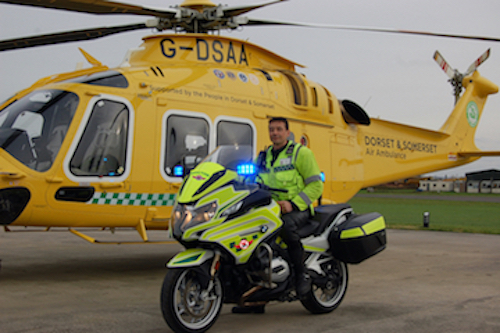
And this is his day off.
Ian is an intensive care consultant at Dorset County Hospital and its former Director of Major Trauma. He is also a doctor aboard the Dorset & Somerset Air Ambulance, a calling that brings him into contact with far too many serious incidents involving motorcyclists. Fanatical about saving life, he has become an expert on how motorcyclists get killed or critically injured on our roads and DocBike is his way of putting that expertise to use for the benefit of all road users, but especially the motorcycling community.
The initiative dates from 2013 and a conversation Ian – who’s also former Chief Medical Officer with Dorset Police – had with PC Chris Smith from Dorset Police BikeSafe. Although Chris had been instrumental in changing the behaviour and atmosphere of the Tuesday night Bike Night on Poole Quay, making it more family-friendly and less about pulling wheelies up and down the Quay, both recognised that there was still a lot of work to be done engaging with bikers to prevent death and injury by making them better riders and educating them about roadside critical care.
Ian explains: ‘The trouble is, a police officer may have difficulty engaging a biker about road safety – it just won’t happen – so we hit on the idea of putting someone other than a police officer on a bike. Everyone loves the Air Ambulance, especially bikers who raise thousands of pounds for it every year, so an Air Ambulance doctor on a DocBike is a big draw at bike events. Once you’re chatting with people, you can share all sorts of information, from how to avoid getting knocked off your bike to general health advice.’
As well as being available to attend incidents and provide life-saving critical care, DocBike runs BikerDown, a free course in which motorcyclists can learn how to keep a fallen biker alive until the emergency services arrive.
‘The biggest threat is to men aged forty to sixty on powerful bikes,’ says Ian, ‘but the progression from a learner to an extremely powerful bike can be rapid, so we want to work with the authorities who set riding tests to make sure they are appropriate.’ That’s a tall order, but it is an absolute passion for Ian and so obvious is his determination that it would be a brave soul who would bet against him achieving it. How he finds the time is something of a mystery, even to him. ‘We joke that my wife is like a single parent because it’s her that takes care of the washing, cleaning, cooking, kids’ schooling, shopping, all that, plus she works as well, whereas I just waft in and out. But it works for us and we make sure we make time for each other and for our kids, who are in their early teens.’
DocBike is part of the National Motorcycle Working Group and is leading a ten-year research strategy into motorcycle injury prevention in collaboration with the Department for Transport, Highways England, the Trauma Audit & Research Network and academics from around the UK. It is also exploring ways to engage with South Western Ambulance Service in injury prevention as the police and fire services do.
Ian claims that he is no different to lots of people living very busy lives and he is determined to retire one day. The typical life expectancy for an intensive care consultant is just two years after retiring so when he hangs up his stethoscope, it will stay hung up. That’s when he will travel the world, but until then he is happy to stay in Dorset because, he says, ‘it has everything you could want.’ He is full of praise for Dorset Police and the office of the Police and Crime Commissioner for continuing to fund more BikeSafe courses than anywhere else in the UK outside London.
‘Dorset is a wonderful place to bring up a family,’ he continues, ‘a great place to visit and we have lots of lovely country roads that can be very dangerous if you don’t know how to read them, but also great fun to ride if you do. We have to be realistic in how we engage with motorcyclists and there’s no point in telling them to stick to the speed limit, because many of them won’t. It’s far better that we train them in the appropriate use of speed. Police drivers are the fastest drivers on the road: in an emergency they get from A to B quicker and safer than anyone else because they have been trained, but that training is available to all of us. So if we ask bikers for their help in preventing collisions that cause death and critical injuries on the roads, if we say we can make them more skilful riders, then we have something we can work on.’
Bike safety – the Lawrence connection
DocBike may seek inspiration from the part Dorset has already played in the development of motorcycle safety. The death of TE Lawrence from injuries sustained when he was thrown over the handlebars of his Brough Superior motorcycle near Bovington Camp on 19 May 1935 deeply affected one of the doctors who treated him, a young neuro-surgeon called Hugh Cairns, who realised that Lawrence’s life might have been saved if he had been wearing a helmet. At the start of World War 2, as a consulting neuro-surgeon to the British Army, Cairns researched head trauma in military despatch riders and in 1941, as a result of his subsequent report, it was made compulsory for military motorcyclists to wear crash helmets. Yet it wasn’t until 1973 that the wearing of crash helmets became the law on all Britain’s roads.
• First published in Dorset Life The Dorset Magazine.