Once the preserve of elderly relatives and long winter nights, the humble jigsaw puzzle has been undergoing something of a renaissance of late and at the vanguard of this resurgent interest is a family-run maker based in converted farm buildings on the outskirts of Ashmore.
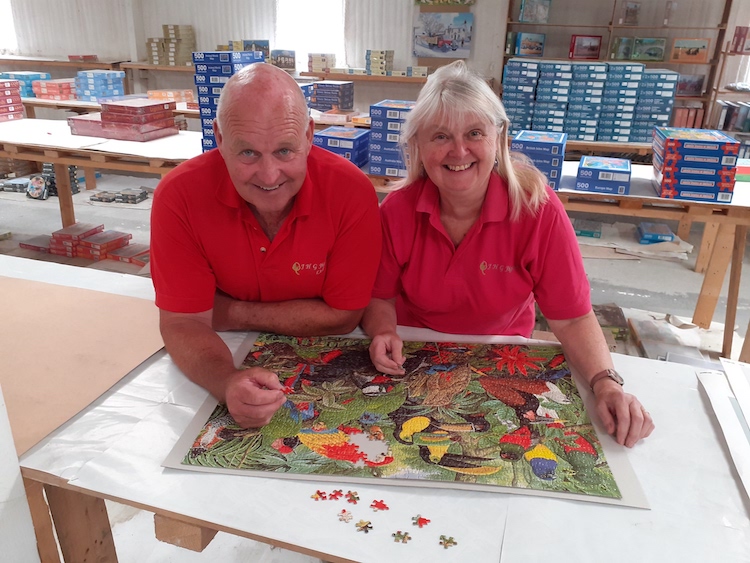
‘There’s something very gentle and calming about doing a puzzle – it won’t go off, it’ll still be there when you come back to it. That’s what people like about it,’ says Julie Wilkins of JHG Jigsaws, the company she runs with partner Brian Knight and Poppy, their three-year-old Labrador who’s senior greeter and part-time guard dog.
A lockdown success story, JHG saw business boom during the pandemic attracting the attentions of national newspapers and broadcasters. Even now that demand, as expected, has dropped back a little the company employs more people than ever and business is considerably ahead of where it was pre-pandemic.
Julie’s interest in puzzles dates from a childhood brush with glandular fever – ‘I was very poorly and my mother, bless her, made me knit and do puzzles to keep my fingers moving,’ – but never considered making a living from selling them until 1997 when she took early retirement from her job as a bank manager.
In the first five years JHG expanded from just twenty images to more than 150, specialising in nature and wildlife, before an opportunity arose in 2008 to buy puzzle-making machinery from an established manufacturer who was about to retire. By then Brian, a builder by trade, was also considering retirement.
‘Basically, that’s how we fell into the puzzle-making business just as the world went into economic meltdown,’ says Julie. ‘I’m the face and voice of the business, Brian is the heart and blood that drives it, but we do a bit of everything – whatever it takes to get the job done – and so do the people who work for us, they’re wonderful.’
It was an inauspicious start though. Despite having seen the machinery in use and spoken to its operators, when it arrived from Manchester there was clearly much more to it than had met the eye.
‘It was a struggle,’ says Julie with a smile on her face. ‘‘We got the machines in and there was one that we couldn’t even work out how to turn on, another that we didn’t know how to regulate and we had to discover how to feed plastic into another one. There was no learning curve – it was straight up.’
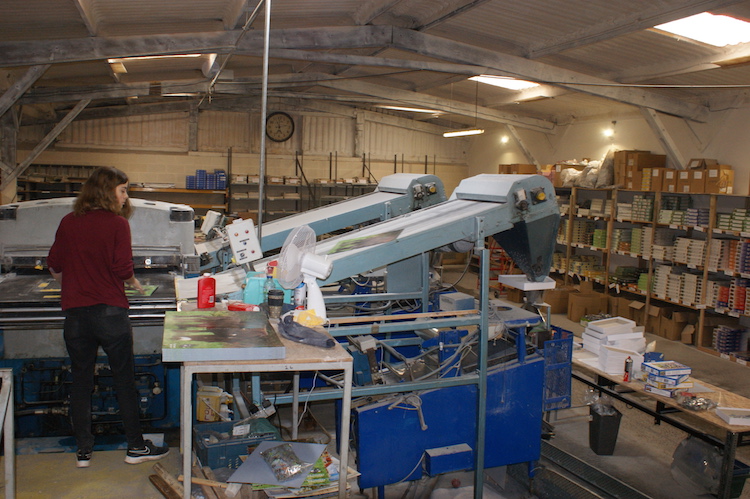
Notwithstanding the noisy machinery, puzzle-making is a surprisingly labour-intensive process. Images are pasted onto puzzle board and box lids by hand and puzzles are cut (against gravity, not with it) one at a time on toggle machines made in the 1970s to press out car engine gaskets. Once cut, the pieces are separated by a rubber flail and fed into plastic bags that are heat sealed on a machine once used to bag Smiths crisps.
‘The machines can be a bit cranky, but they get the job done with a bit of coaxing and careful management,’ explains Julie.
‘And we keep ploughing away. Puzzles have never been trendy, but even before Covid the signs were there that interest was gradually growing on the back of a revival in craft making and puzzles were put back in the basket of goods they use to calculate the cost of living.
‘Still, nobody could have predicted what happened in lockdown. Many people had a terrible time, but we kept on working – we’ve got 12,500 square feet of space so had no trouble distancing and we’re fanatical about wiping down and sanitising. The staff chose to work or go on furlough if they had small children and after one news agency report suddenly everyone wanted to know about puzzles.
‘At the height of the 2020 lockdowns and into 2021 we were making to order as all our stock had sold. Then we were on Jeremy Vine and the website orders went into overdrive.’
It’s an eco-conscious marketplace and few exceptions are made for puzzles, so the starch and water based glue is soluble and edible – JHG make children’s puzzles – and while they’d love to stop using plastic altogether, inevitably there’s a cost implication. Small runs and bespoke orders can be wrapped in tissue, at a price, but not the main production lines.
‘Honestly, the Chinese can land a puzzle for about half of what it costs us to make one, but customers know what they’re buying when they deal with us and they have to expect to pay between twelve and fifteen pounds for a well made 1000-piece puzzle. We use locally sourced and recycled products wherever possible – although puzzle board is only made in Holland – but every single item that leaves this factory has been made by hand in some way.’
As is the cake that comes out with the coffee when Julie hosts factory tours and talks for local groups and dedicated customers.
JHG’s stock items lean towards ‘chocolate box pretty’ where historical accuracy and even perspective are less important than overall easiness on the eye. Tractors are very popular, as are classic cars, cottages and historic maps in a range that extends to some 800 images. Artists licence the puzzle rights to their work and are paid a royalty on sales.
Clients for bespoke and short run orders range from individual shops and artists all over the UK to swish London art galleries – recent orders have been made for the American hip-hop producer DJ Shadow and British rock singer Tim Burgess of The Charlatans whose social media listening parties for classic albums united thousands of music fans in lockdown. JHG has also made puzzles for Max, Paddy and Henry, the internet sensation ‘miracle’ dogs recognised for the positive impact their online antics have on people’s mental health.
‘Any image can be made into a puzzle,’ says Julie, ‘and we’re always interested in new images as long as they’re right for our customers. If something is a bit risqué we’ll ask everyone here first if they’re happy with it. We’ve done a Renoir recently, a vampire image, and lots of puzzles for punk bands for some reason. We also supply a donkey sanctuary and the gift shop at Sandringham – we know Her Majesty likes a puzzle.
‘We don’t know if she has one of ours though.’
www.jhgpuzzles.co.ukwww.jhgpuzzles.co.uk
• First published in Dorset Life The Dorset Magazine