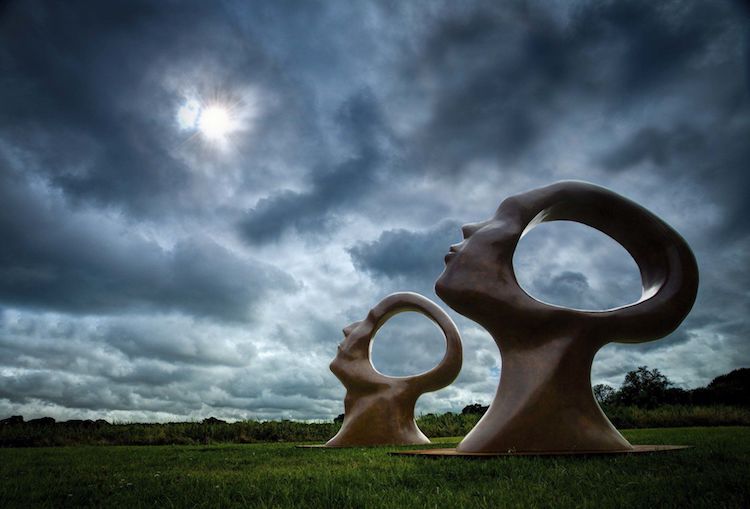
Sculpture by the Lakes is a work of art in its own right, a haven for people and for sculpture where natural beauty is enhanced by the hand of man – one man, Simon Gudgeon. The soft lines of his monumental work somehow slip effortlessly into the landscape around Pallington Lakes as if the most natural thing in the world to find in this sanctuary for the soul is a pair of giant tilted heads you can look through.
They’re quite wonderful.
With some forty other large-scale works they sit serenely in 26 acres of low lying land where peace and quiet are interrupted only by birdsong and gently flowing water along loping riverbanks that give way to four man-made lakes, the result of gravel abstraction in the 1970s. In the woodland and adjacent meadows dissected by paths and trails are concealed hideaways for the contemplation of all this restorative beauty. It is a most remarkable place where time can slip away and whatever concerns lie beyond its confines can seem a very long way away indeed.
‘There is something very special here; the place speaks to you,’ says Simon who, with wife Monique, has built the park over the last fifteen years. ‘The number of times people tell me that they walk up the drive here to the park and feel their everyday stresses falling away, that’s a lovely thing to hear. We feel it as well – except for the fact that for us our everyday stresses are right here!’
One of Britain’s leading contemporary sculptors, Simon is best known for his public works, large-scale bronzes such as Isis in Hyde Park – the first sculpture to be installed there for fifty years – and Search For Enlightenment, the instantly recognisable monumental heads that now serve as a visual calling card for Sculpture by the Lakes. Three generations of the Royal Family own his work, as does Pink Floyd founder Nick Mason.
A Yorkshireman by birth and one-time city solicitor, he also worked as a photographer, insurance salesman and gardener, only taking up painting in his thirties while working as a house sitter after the collapse of his landscape gardening business. He was 40 when an impulse buy of artist’s clay lead him towards sculpture on a quest to respond to that which lies closest to his heart – the natural world.
And while it would be stretching a point to claim Simon’s work is specifically about Dorset, when viewed in the context of this peaceful stretch of the Frome, it has very clearly become part of Dorset, assimilated with ease by the gentle landscape.
‘Everything I make now is for here,’ he explains, ‘so this is a huge part of what I do now and I think, increasingly, this place tells me what to make. I love it that you can position sculpture here so that it enhances and is enhanced by the landscape, but I see the whole place as a work of art. I’ve made the tables for the cafe, the gates, fences. I’ve built the new riverside arena. There’s never been a vision and we’ve never made a plan, we’ve just learned the lessons along the way and listened to what’s needed.
‘For instance, I love cooking over wood with the whole theatre that entails so we have a brilliant full-time chef and a sous chef and between us we cover the cafe and the new outdoor kitchen with the pantry selling quality prepared food so people can build their own picnics. If I love it then I’ll do it.’
Sculpture by the Lakes comprises five separate limited companies and a growing cohort of staff. It’s a time consuming business that necessarily keeps Simon from his studio. Nevertheless, he has just installed Parallel Passé, the latest of his figurative ballerina latticework sculptures and his passion project, a stunning five-metre tall kinetic sculpture called Sail, is due to be installed by the autumn.
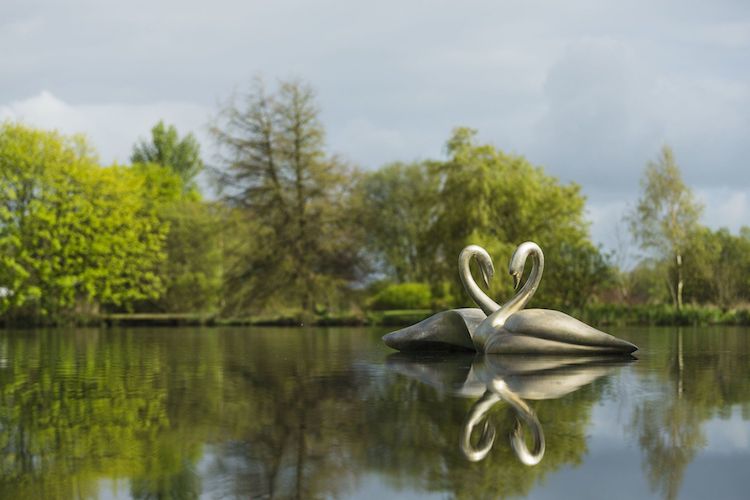
‘I get less time for sculpture than perhaps I would like, but I am still making, still creating. Each sculpture should be an event. So, each sculpture is different depending on the time of day, the weather, the season; a sculpture set on water will offer a reflection – two pieces for the price of one if you like – in certain conditions and be something else if it is raining. What you see through and around the pieces is constantly changing, so the pieces are never the same twice.
‘Sail came from an idea I pitched for the 2012 Olympics that wasn’t successful. It’s set in water with a 360-degree gyroscopic joint and counterweights beneath and it is moved by the wind – I’ve no idea how we’ll install it, we’ll sort that out when it arrives. I’m really excited to see it the finished piece.’
He tells me he was just as excited at the launch of the park’s outdoor kitchen and riverside arena at the Dorset Tourism Awards in May and feels the quickening every time a new idea takes hold.
‘I love travelling and picking up new influences – the times when you’re away from the studio are probably when you are most creative because you’re unable to do, so you think. That’s when ideas arrive, then they get refined and evolve, they can sit in my head for years – Isis was there for six years before I had the opportunity to create something for a space in Hyde Park. It was a completely open brief – if you could put a sculpture there what would it be?
‘Very rarely will an idea arrive fully formed, but Search For Enlightenment was one of them. We were in the Karoo Desert in South Africa at a friend’s place, up a mountain watching the sun set. It was stunning. I knew the age of the mountain and what it had taken for it to form. I was watching people craning their necks watching the stars come out and thinking there are more stars up there than there are grains of sand down here, feeling that insignificance, when it hit me. Bang! As soon as we got back, I went straight into the studio and made it.’
Having bought the site in 2007, just months before the Global Financial Crisis, Simon and Monique had a vague idea of making a living from the pre-existing fishery and using the grounds to show sculpture to prospective clients, but gradually realised they had a blank canvas on which they could shape their own future. They gave themselves 18 months to prepare the site, closed the fishery, and opened Sculpture by the Lakes in June 2011 in aid of forces charity Help For Heroes.
Much has changed since those first few weeks and today it is a multi-faceted, year-round business that local people and visitors alike have taken to their hearts.
‘It goes to show you don’t always know what’s around the corner. I’m not a big fan of straight lines, you don’t see them in nature, I like curves and that’s how the park is designed, the paths are curved there’s always an opportunity to be surprised, to discover something that will elevate the experience of being here. We planted thousands of trees and shrubs so that from the house we come out into quite formal gardens that get wilder as we come into the park where we left the grass and only mowed the paths. Now we’re up to around 120 bird species in the garden and just last week I saw our first pair of marsh harriers down by the river.’
Simon’s obvious enthusiasm for his art, his business, his life is undeniably infectious and he’s just as passionate about the possibilities for his adopted home county.
‘Obviously, the pandemic changed a lot of things, one of which was that people went away in this country and suddenly Dorset got this influx of people seeing it in a different light and they liked what they saw.
‘What’s needed are centres of excellence, places that do what they do really well, and Dorset has several now. For instance, when you get a really excellent fish restaurant, like the Catch at Weymouth, that ups the game for everyone, and when there are a few centres of excellence it gels into an experience that people take away. That’s what we’re tapping in to here. What stays in people’s mind are memories, experiences, the things they have done and seen.’
He’s a busy man, but just before returning to the business of the day, Simon pauses and savours a passing thought: ‘This is our life project, this is home – the only way we’ll leave here is in a box… a very big one, obviously!’
And with that he’s off.
::
Sculpture by the Lakes
Open Wed-Sun, 10.00
Entrance by pre-booked tickets only
• First published in Dorset Life The Dorset Magazine.