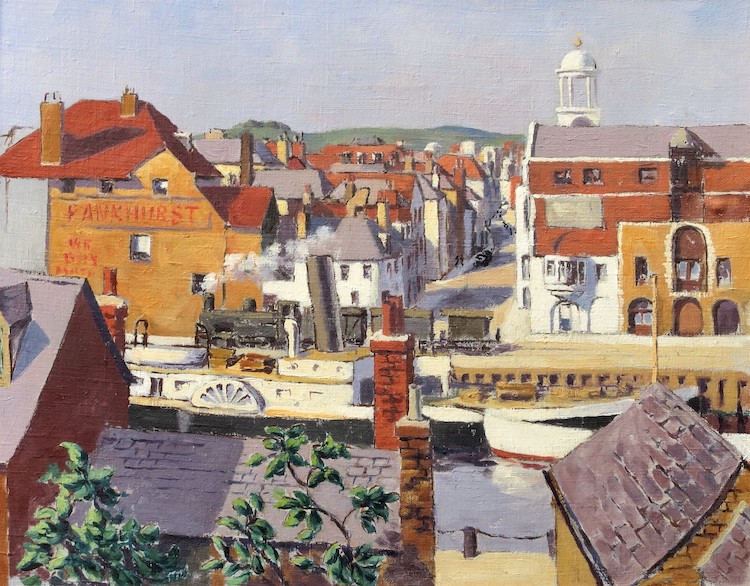
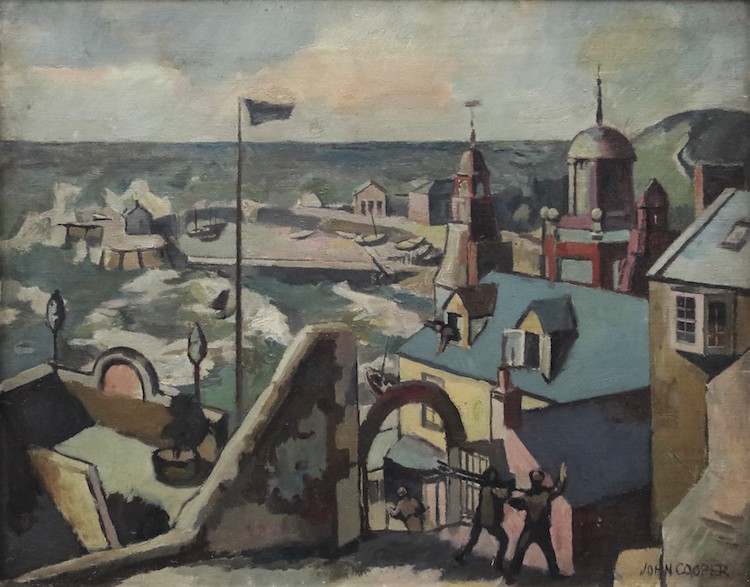
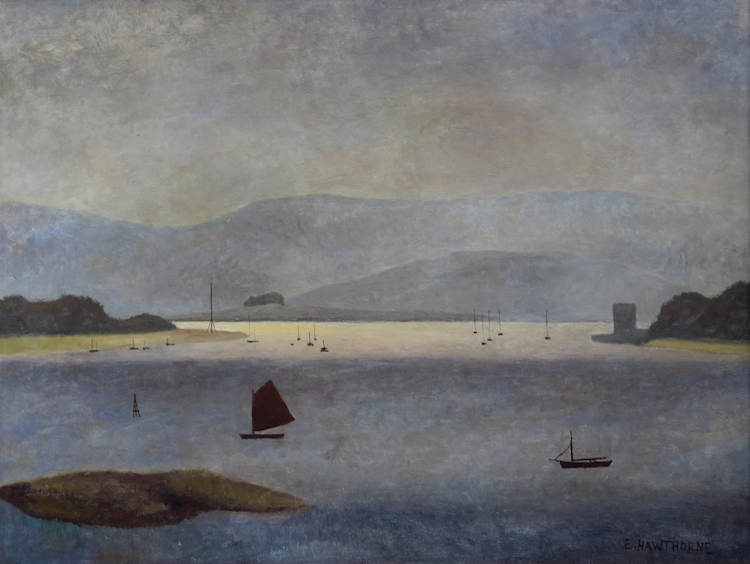
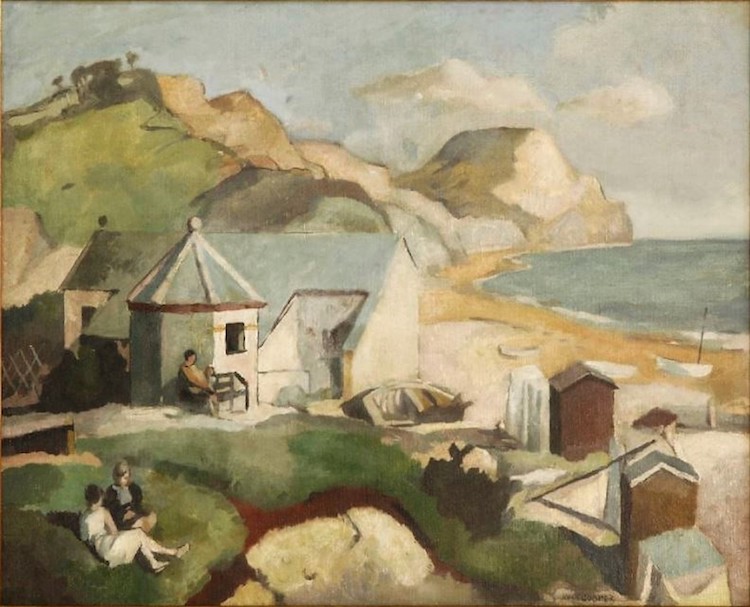
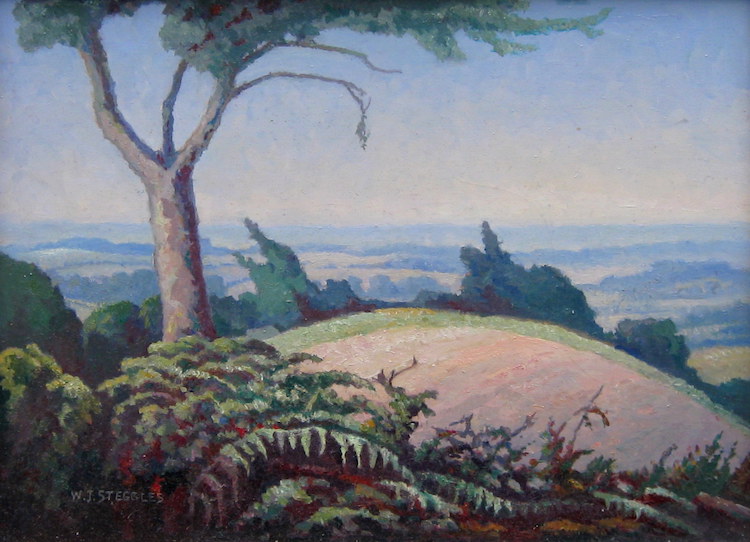
Dorset’s highways and byways, countryside and coast have provided inspiration to some of our greatest artists at least since Turner and Constable went canvas to canvas under its skies in the early 19th century. So to find artists from the much-feted East London Group between the wars were just as taken with its scenery is considerably less of a surprise than that they were ever here at all.
They were the young, working class men and women who learned to paint at evening classes in Bethnal Green and Bromley-by-Bow tutored by the British Impressionist John Cooper, a greengrocer’s son, and mentored by his fellow Slade School graduates Walter Sickert and William Coldstream. Formalised as the East London Group in 1929, by the early 30s the group was the toast of the London art set and members’ work was shown alongside that of Degas, Gauguin, Monet, Renoir, Cezanne and Picasso.
Indeed, by the time of arguably their most prestigious showing when group members Walter Steggles and Elwin Hawthorne exhibited with John Nash, Barbara Hepworth, Augustus John and Philip Wilson Steer at the 1936 Venice Biennale, the East London Group were considered very much the equals of such British art grandees. Their works were collected by aristocrats including the Earl of Sandwich, Viscount Hinchingbrooke and Lady Cynthia Mosley, as well as writers like Aldous Huxley and Arnold Bennett, the singer Paul Robeson and politicians such as Ramsay MacDonald and George Lansbury along with the cognoscenti of the art world. Nearly 80 examples are in the national collection.
The end of World War 2 heralded a new age, public taste shifted, and following John Cooper’s early death in 1943 the group faded from view. Its membership that had numbered as many as 33 exhibiting artists mostly returned to the task of earning a living that would support their families and for fifty years or more the work of artists such as Walter Steggles and his younger brother Harold, Elwin Hawthorne and his wife Lilian Leahy, Phyllis Bray (Cooper’s wife), Albert Turpin, Henry Silk, Cecil Osborne and Brynhild Parker was known only to a tiny few.
Slowly but surely, the group’s name and fortunes have been restored and revived over the last ten years or so thanks in no small part to the efforts of Dorset farmer’s son Alan Waltham, a retired engineer and hard landscaper, and his wife Janeta, the Steggles’ niece. They found themselves de facto custodians of an extensive and chaotic archive when charged with looking after the contents of the house her uncle Wally (as Walter was known to the family) had shared with his sister Muriel and subsequently left to Janeta’s mother Dilly, his last surviving sister, in 2009.
It was quite an introduction to the art world, says Alan: “I’m a farmer’s son from Purse Caundle, what did I know about art? Janeta studied Art to A-level and we loved walking around art galleries, but we didn’t know about the business of art.
“Wally had these two bureau bookcases stuffed with books and bric-a-brac, he collected and kept everything, but the drawers underneath were filled with papers, bags, bills, exhibition catalogues, sketches, paintings, you name it. There were canvasses all over the house. We found seven oil paintings in the garage and on the day of the eventual house clearance several linocuts by Elwin Hawthorne fell out the back of a drawer from an old kitchen cabinet.”
Despite the group’s name little more than a quarter of the 730 paintings attributed to the group and listed in exhibitions feature the streets of East London. In fact, the majority of the work captures rural and coastal scenes in Essex, Suffolk, Kent and, indeed, Dorset.

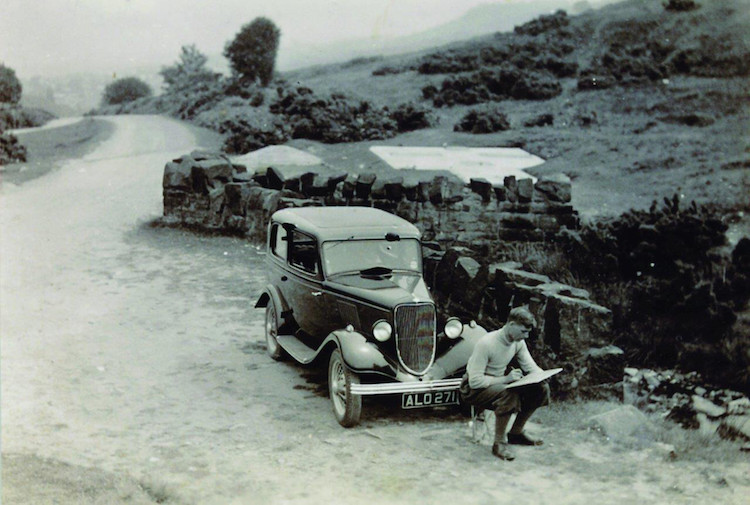
The link was probably made through John Cooper’s friendship with Slade School graduate and future Admiralty war artist Richard Eurich who was in Lyme Regis over the winter of 1932-33. Harold and Wally were enthusiastic travellers and bought the family a small Ford 8 car using money made from the sale of paintings – they were selling 10-15 paintings a year at 12-25 guineas, considerably more than the 15 shillings a week Harold earned when he started work aged 14 as a junior clerk at a City of London law firm in 1925.
Disappointed with the fruits of a painting trip to Devon and Cornwall in 1938 the brothers stopped in Dorset on the way back to their Romford home and made a series sketches and paintings. They returned several times and exhibited paintings in 1938 entitled Affpuddle, Briantspuddle, Wareham, Dorset Landscape and Chesil Bank from Portland, as well as a sketch of Corfe Castle. Fellow members of the East London Group also painted at Poole Harbour, Weymouth, Charmouth, Stoke Abbott, Lyme Regis and the Purbeck Hills. In the early to mid 1980s Wally also painted the road to Edmondsham, near Verwood, as well as other views of Dorset from Bulbarrow and Pilsdon Pen.
“Wally didn’t often talk about painting, but if you got him going bits and pieces would come out. He said Sickert and Cooper had encouraged them to paint what they knew around them in the streets where they lived. When they travelled they took the same approach. Sickert also said paintings should have a ‘look here’ quality, which is why some of their works break conventional rules of composition yet you can’t take your eyes off them – there are some that seem to show different things every time you look at them.”
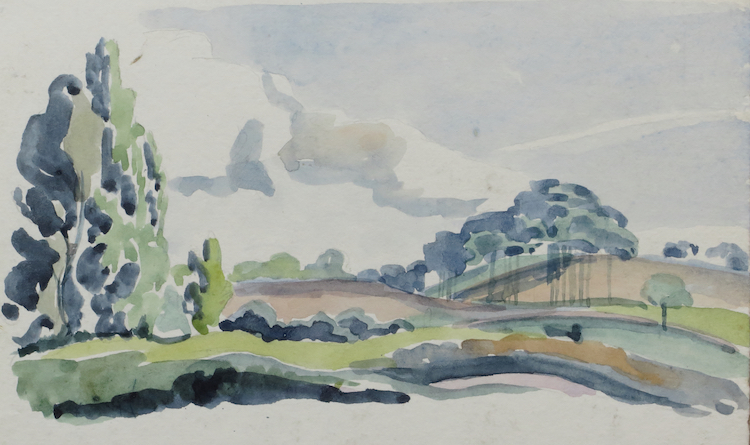
As we talk Alan produces numerous photographs, sketches and watercolour studies for paintings, including a sketch for Wally’s Affpuddle painting complete with grid marks and pencil lines that he places next to a more detailed watercolour sketch.
“Hang on, that’s the same view!” he exclaims. “Until this minute, I had no idea. There’s no annotation on the watercolour and I’ve never seen them side-by-side. Things like that are happening all the time, even now.”
There’s a great deal more than family pride at work here. The renaissance of the East London Group has attracted widespread coverage, interesting the BBC’s then Director General Tony Hall, and has been the subject of an Inside Art documentary on Sky Arts. During his time as Director of the Tate, Sir Nick Serota was in personal contact with Alan about the group’s work having previously been Director of the Whitechapel Gallery, which had hosted East London Group exhibitions in the 1920s.
“On day one when we looked at the contents of Wally’s house we had absolutely no idea where it would take us,” admits Alan. “There’s obviously a family bias in how we feel about the paintings, so all the attention is not only very reassuring, but it feels very organic – it has found its own way to us.”
The seeds of the revival were sown in the late 1980s when journalist David Buckman interviewed Wally and other surviving artists in researching the group’s history. The eventual appearance of his book, From Bow to Biennale: Artists of the East London Group, in 2012 and a series of accompanying exhibitions provided a solid base from which interest has gradually grown. Alan created two websites – one for the group and another solely for Walter’s work – and launched the East London Group Twitter account on 1 December 2013.
“We had 60 followers within an hour and by early January I was getting between 150 and 400 new followers a week and welcoming each one with a personal reply and an image file, I was literally overwhelmed.”
The feed now has some 25,000 followers.
“It’s remarkable really,” says Janeta. “I remember my uncles as lovely men, very different, as were their painting styles, but they got along extremely well. We all knew about the painting and pieces were dotted about the family, but it was just something the boys did, it wasn’t really talked about that much so we didn’t really appreciate their importance.”
Harold stopped painting after World War due to the arrival of his daughter and the increase in his workload for a firm of solicitors at Grays Inn where he eventually became a partner. In the mid-1960s he was diagnosed with leukaemia and started to paint again as a form of therapy, but died in 1971, aged 60. Wally though painted all his life, especially after retiring from his job at a shipping firm in 1967 and in later life often returned to sketches made between the wars to complete landscapes he had seen and photographed. He died in 1997 at the age of 89.
Where are they now?
From exhibition catalogues and group records Alan has identified a number of Dorset paintings, or work likely to feature Dorset scenes, that remain unaccounted for.
These are works that in many cases have been exhibited and, quite possibly, sold but have slipped from public view. Given that the work of the East London Group artists fell out of fashion for so long the hope is that they may yet turn up and could be included in a forthcoming exhibition in Dorset of ELG work.
Who knows, perhaps they are on your wall, in your loft or store cupboard?
by John Cooper:
Lyme Regis
Churchyard, Lyme Regis
Stoke Abbott
Dorset Coast
by Phyllis Bray:
St Gabriel’s, Dorset
Weymouth Harbour
Coast Scene
Sea Shore
by Walter Steggles
Affpuddle
Bryantspuddle (sic)
by Harold Steggles
Wareham, Dorset
::
An exhibition of work, some of it unseen for 80 years, is on show at Lighthouse Poole. East London Group: Dorset Days runs until 8 April 2023 and focuses on paintings and sketches of Dorset.