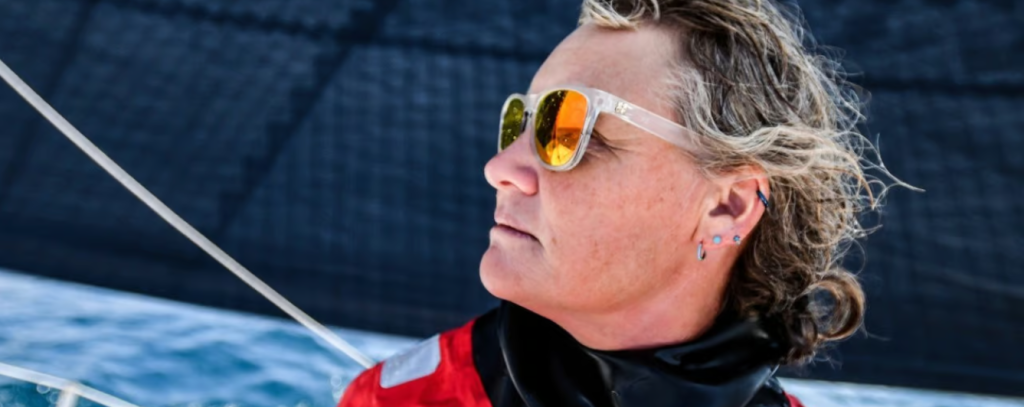
Relentless in pursuit of her goals, Poole yachtswoman Pip Hare is one of just eight women out of ten who have completed the Vendée Globe single handed non-stop 24,000-mile round the world yacht race – more men have walked on the moon. A physical, mental, emotional, spiritual and psychological challenge like few others on Earth, she’s had this year’s Vendée in her sights ever since she crossed the line on the last one.
It starts on 10 November and, as she’s happy to tell her audience at Lighthouse on Tuesday 27 February, she’s ready.
“I went into that last race, and I had the second oldest boat in the fleet; I had only managed to get my title sponsor four months before the start, and I’d been sailing IMOCA [class] for two years – I was a total rookie.”
Nevertheless, she confounded all expectations (other than her own) and came in 19th place. A staggering achievement, but that was then.
“Success is a different beast this time,” she says. “We’ve had investment. We’ve had a three-and-a-half year run up to it and we’ve made some big alterations to the boat. So, I really want to be comfortably inside the top ten – that’s what the boat is capable of.
“The next thing is: what am I capable of? Well, I’ve just got to push myself and find out really.”
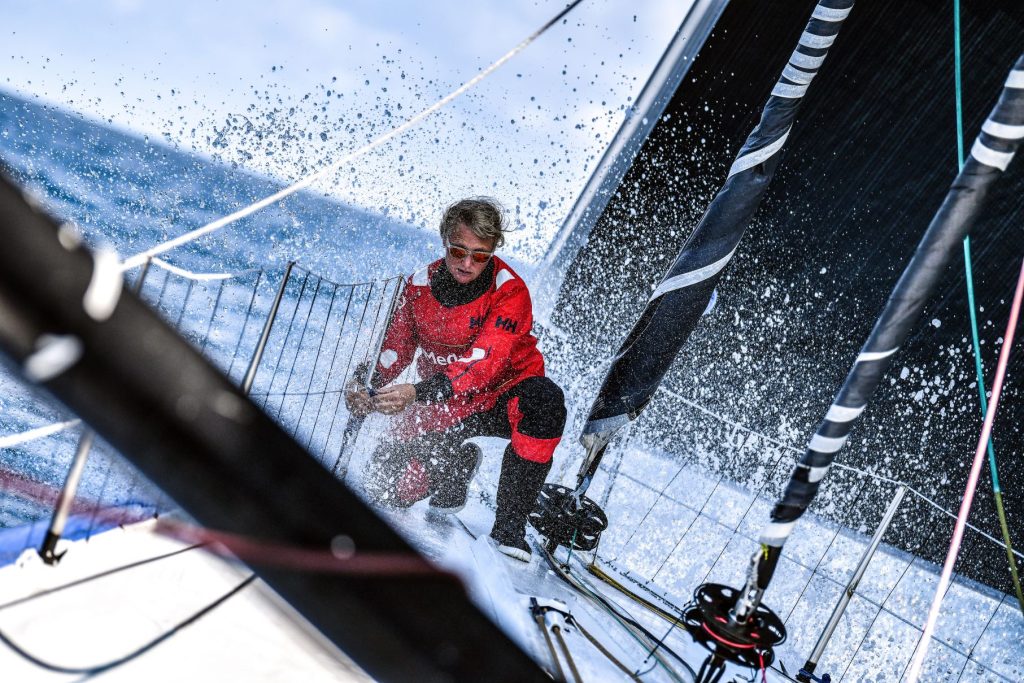
When Pip talks of pushing herself, she’s on about ninety-plus days of navigating the ocean in sole control of one of the world’s most powerful race yachts in the face of fearsome weather conditions in a state of perma-exhaustion. Cold, wet and alone. Day after day. It takes a special kind of person to even want to do that and an even rarer one to achieve it.
Although she has been around the professional sailing world since she was teenager, it has taken years of hard work for Pip to claim a place at the top of her sport and she’s passionate about creating a pathway for others to follow.
“Part of the reason I talk about what I do is because I want to drive some sort of change,” she explains. “It was very difficult for me getting into the industry as a woman in the 90s. Even now, for people from non-traditional backgrounds, people who didn’t grow up by the sea, who didn’t have sailing in their lives when they were children, it’s really hard to get into the sport or to even understand what opportunities there are in the sport. So, I want to demonstrate to a wider audience what it’s all about.”
Slowly but surely, Pip has found herself at the centre of a small but growing community of expertise in elite team ocean racing in Poole, her home port since 2012 when she moved to the area to take up a post at the RNLI.
“My absolute vision is to create a bigger team based in Poole, potentially a two-boat team with an older boat for a youth team and a new boat for a performance team. Then I would love to have entry level programmes for the shore side of things, for race management and préparateurs and riggers, because there are great career prospects there.
“For example, managing the logistics of a race team that goes around the world is as complicated as an F1 team. We pack up, we take our workshop, we take our technicians, we go to race villages, we prepare on the pontoon, which is like the paddocks, we spend a week in race villages beforehand, we do speed runs to start off with. We take everyone on tour and the boat has to be immaculate and well prepared. If I had a massive sponsor that’s what I would do with it.”
It’s all about the money. Pip sailed her first Vendée on a relative shoestring with expectations to match. This time her yacht Medallia has been upgraded with high foils that last summer saw her hit speeds of 29 knots without driving it as hard as she knows she wants to. In December, she finished eleventh in the Retour à la Base transatlantic race, missing her target tenth spot by just 21 minutes – a hair’s breadth in the world of ocean racing. But as preparation for the Vendée it was invaluable, not least because for the first time she’d been able to “really let the hand brake off” and feel exactly what the boat is capable of.
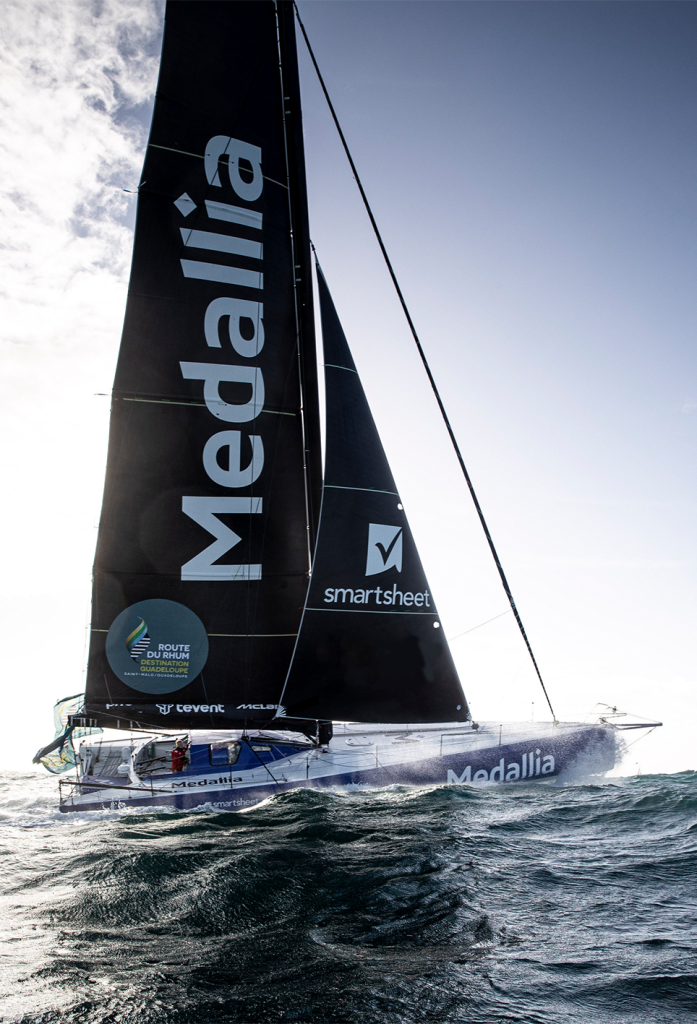
However, the learning continued all the way home as the exhausted Pip departed for Poole immediately after finishing the race and her team had to deal with a potential crisis when she ran the boat aground off the coast of Cornwall. In her talk Pip will explain how the team pulled together to react to the situation and how the learning from the incident has made them stronger.
“It would have been my first top ten finish in the fleet and an incredible way to finish the year and I knew I was capable of it. I had a lot of technical problems early in the race, but I was outsailing the boat, and I finally came into tenth position about 36 hours before the finish. Then I lost it three hours before the finish, and I was devastated, just crying my eyes out and so exhausted, so emotionally run down. Then you have a moment where it’s ripping the plaster off, that deep pain and disappointment, but you don’t have a choice, you can’t stay in that state, you have to galvanise, you have to zoom all the way out just to get some perspective on it.”
It’s often said that there’s more to be learned when things don’t go to plan.
“I know my superpower is my ability to endure, to just keep standing up – every time you push me over, I get back up again. I know I sailed a great race. I know I’d demonstrated what the boat is capable of and there was nothing that I could have done in that last three hours to change that outcome. So, it was just taking that perspective and my team finished the season unbelievably happy and positive that we’d got that far.”
Pip’s immediate goal is clearly the next Vendée, but what about the future? What’s next?
“One of the reasons I am so I love with this sport is because you are never, ever, ever going to hit the limit of what is possible. The boats will keep advancing, the engineering, what we’re capable of as human beings in terms of how we build things, the structures, the design, the imagination. I love it; it’s great!
“Poole is a great location and really well suited to the kind of sailing that I do. It’s so flat and sheltered in the Harbour I can put my sails up, then when we get to the end of the channel, I’m in the English Channel, turn right and in less than 18 hours I can clear Land’s End and I’m in the Atlantic.
“Would I do a third Vendée? I don’t think I’d rule it out now, but if I had to make that choice to step back from a third Vendée and in return I could develop an incredible Ocean Racing team and culture in Poole I’d probably go for that because I’d still get to go sailing – they’d have to take me sailing.
“I have to be allowed to go sailing!”
For more about Pip Hare and to find out about sponsorship opportunities, visit https://www.piphare.com/
Full interview transcript
INTRO
A professional sailor from the age of 18, Pip Hare has covered thousands of sea miles in some of the most competitive ocean races in the world. Unrelenting in her pursuit of excellence, four years ago she completed the Vendée Globe – one of only eight women ever to do so – sailing a non-foiling boat against the world’s best and finishing 19th.
For this year’s race her sponsors Medallia decided to reach for more and increased their support enabling her to buy the foiling Imoca 60 that has finished third in the 2020-21 race.
Now named Medallia, modified and with new foils, Pip finished the transatlantic Retour à La Base just outside the top ten she had set her sights on. She missed out by a mere 21 minutes – a hair’s breadth in ocean sailing terms – serving only to redouble her preparations for this year’s Vendée that gets underway in November.
That she does it all from her home port of Poole is very much in keeping with Pip’s quietly pragmatic view that these things are better done close to home away from the sport’s de facto Atlantic coastal hub at Lorient.
So, what is it about Poole?
Most of the teams are based in Brittany and the real hub is Lorient, which is amazing. There’s one marina, La Base, and every top French team is there high watering. You just walk round the pontoon salivating, it’s unbelievable. I have trained there and been based there in previous campaigns, and it is definitely the mecca. It’s easy to be there because there is such a body of knowledge – you rub shoulders with other teams, you ask advice, you can find sub-contractors to do work, you can jump on someone else’s boat and go sailing and learn, it is this incredible atmosphere of growth and development.
But when I first started out this was where I lived, and I needed to fundraise at the same time as running the boat and working too and so I couldn’t just go to France, that wasn’t an option. Poole Harbour Commissioners driven largely by Kerrie Gray, who is the marina manager, offered me a berth and said I can base my campaign here.
The reason for that is they just wanted to promote Poole Harbour as the place that bigger boats can come and would be welcome. There is this idea that it’s shallow, so for them it’s about establishing the credibility of Poole as a centre for sailing, and we all know how great it is here. There are so many good clubs, we deliver a load of world champions, youth squad members, but in terms of the big boat sailing there’s still this idea that all the action is happening in the Solent and so they were really happy to host me and have carried on with that.
When I got my second campaign everyone assumed I would go to France, but I would really like to drive some sort of change in attitude towards sailing in the UK, just make it more accessible, encourage people to get into it, and create some sort of visible pathway for young people or older people who want to come into the sport. If I just disappear off to France as soon as I hit the big time, then I’m not helping that.
Staying here was important to me and we have generated a small community around what we do. I know people love to come down and see the boat on the Quay, we’re always being stopped by people asking my team how it’s going, and when I go in and out people come and watch the boat. As a small sponsorship package we were donated a small office inside the Gallagher Building on Poole Quay and Deli on the Quay support us with events.
So, we’re creating this community feel which is very much the way that it is in France. The communities in France are proud of their sailing teams and it feels we’re making baby steps towards that. The difficult thing is, the minute I stop it all stops, everything stops.
At the moment, all of our talent, not just in terms of the sailors, also in terms of the specialists in boat preparation and data management, they’re all going and working abroad because we haven’t got any British ocean racing teams based here. We’ve got Alex Thomson Racing and Gentoo Sailing on the Solent, but we’ve got something to build on here in Poole. I’m aware though that it does depend on people like me being able to create opportunities and unfortunately that does depend on sponsorship because that’s the level of sport that we’re at.
It seems no matter how good a sailor you are, funding casts a long shadow. How does anyone get started?
The difficulty with it is, because these event, just roll and roll and roll, you need to have secured your funding before. It’s the hardest thing about it. It’s really, really hard trying to find access to the right people to talk to them about a project.
In my opinion, it’s a great opportunity, and we know our sponsors have benefitted massively – the return they get proportionately compared to other sports is huge – but it’s still not a particularly well-known sport, so it’s quite difficult to even get to talk to someone about it. However, I do believe, because of the way the world is changing and the way we are consuming media, one of the huge things we have to offer is that our sporting events go on for months and there is really engaging, live, in-the-moment footage from boats over those months, and many different ways to consume it. You’ve got race trackers, all the telemetry that comes off the boats, we’re using drones now, so watching from the outside in.
We really saw that change in 2020 partly because of Covid and there wasn’t any other sport available and the break in the cloud allowed us in, but also every four years the leaps in satellite technology are enormous and we’re now looking at using Elon Musk’s StarLink, which is unbelievable. The antennas are not 100% reliable, at the moment – they don’t like having water over them, which is a slight problem – but when I lock onto a satellite the connection speed is better than my broadband at home!
What we’re going to see now going forward from the boats is going to be of such high quality and so engaging, it’s just a great opportunity.
You’ve embraced social media whole-heartedly with posts that are really informative, sometimes funny, sometimes revealing and always incredibly honest, at times brutally so. You seem very comfortable, but it can’t be easy giving that much of yourself?
It was a conscious decision on my part. I went into that last Vendée and I thought: ‘What’s the definition of success?’ I had the second oldest boat in the fleet. I had only managed to get my title sponsor four months before the start and I’d been sailing Imoca for two years, I was a total rookie.
I had a sporting performance definition of success, I knew how hard I wanted to drive the boat, but I needed another definition, and I knew I needed another return for my sponsors because it just might be a bit hard to understand that I outperformed the boat, that’s nuanced. So, my decision was I just wanted to tell the best story in the English language, and I decided that would be an honest story because that’s true to me.
The fact was, I just absolutely loved what I was doing so I wanted to share it and that’s carried on with me. I have a bit of love/hate relationship with social media in that I don’t consume it particularly and I was aware when I started out that we had to embrace it, but one of the things I always said to my team is I want to be able to look at every piece of social media we put out and believe there is a value to it. I’m not interested in inanities, there has to be some sort of value to it, and I want it to make people feel good and be gentle and kind and informative, and I think we’ve stuck to those principles.
It’s our job, it comes with the territory. We’re asking sponsors to invest heavily in our sport, they have to have a return, and the more we do it the more we’re going to attract investment into the sport, so there is a net gain for everyone.
I’m engaging with the longer, more informative more story-driven video content with more detail. And that’s really interesting because if you look at stats, you’re driving one side of things which is purely about an algorithm which is trying to get as many eyeballs on something as you possibly can, but then with our longer form stuff, the engagement with it is off the scale. People really deep dive into it, they stay tuned to it, they look at it, they watch it because they’re interested. It’s two very different modes of communication now, but I definitely won’t abandon the long form stuff.
You’re also very happy to meet groups and talk to audiences about your experiences in racing, the highs and lows, warts and all…
Part of the reason I talk about what I do and share what I do is because I want to drive some sort of change. It was very difficult for me getting into the industry as a woman in the 90s, really, really hard. Even now it’s difficult for people from non-traditional backgrounds, people who didn’t grow up by the sea, people who didn’t have sailing in their lives when they were children. It’s difficult to get into the sport, or to even understand what opportunities there are in the sport.
I want to show and demonstrate to a wider audience what it’s all about and that it’s not just three seconds of glamour hooning through the ocean, it’s actually a lot of hard work. But there are career opportunities, there are bad bits and good bits, and it takes a huge range of skills as a human being to do what we do as a team.
It’s just that wider understanding of it, instead of this constant image of perfection, which is not real life.
There’s clearly massive focus on the Vendée, but what about the longer term?
I’ve got a plan, but like everything in elite sport it comes down to sponsorship. My absolute vision if I could have any future for the campaign, I would want to create a bigger team based in Poole. We’ve already got a bit of hub in Poole around us, but I think Poole is such an incredible venue for so many reasons.
I could have an ocean race team, potentially a two-boat team, with an older boat we could have a youth team with, and a new boat we could have for a performance team. Then I would love to have entry level programmes for the shore side of things, for race management and préparateurs and riggers because there are great career prospects there and really interesting. For example, managing the logistics of a race team that goes around the world is as complicated as an F1 team. We pack up, we take our workshop, we take our technicians, we go to race villages, we prepare on the pontoon, which is like the paddocks, we spend a week in race villages beforehand, we do speed runs to start off with.
It’s everything there and we take everyone on tour and the boat has to be as immaculate and as well prepared. There is some really interesting career paths there, but it’s really hard for young people to get an entry into it.
But if I had a massive sponsor, that’s what I would do with it.
And if you had to choose between the long-term plan and another Vendée?
Would I do a third Vendée? I don’t think I’d rule it out now, but if there was an opportunity to, if I had to make that choice to step back from a third Vendée and in return I could develop an incredible ocean racing team and culture in Poole, I’d probably go for that because I’d still get to go sailing – they’d have to take me sailing, I have to be allowed to go sailing!
But the other thing to say about Poole, is it is really well suited to the kind of sailing that I do. It’s so flat and sheltered in the Harbour I can put my sails up in the Harbour and we go out with my team, they accompany me out. When we get to the end of the channel, I’m in the English Channel, there’s room. Turn right and in less than 18 hours I can clear Land’s End and I’m in the Atlantic, so it is a great venue.
Poole Bay is really good for data management – it’s flat water, easy to manage – it really is a great location.
We touched on definitions of success earlier, so what does success look like this time in the Vendée?
I always define my success before every campaign, every year within the campaign, every race, I have to know what success looks like. I have multiple definitions of success because in a race like the Vendée, it’s three-month race, you cannot guarantee that you will finish, you just can’t – anything could happen. As a fleet, our biggest worry is hitting things. You could hit something that would break the boat and you can’t carry on; or dismast.
And if those things happen you have to have already made sure that you have other definitions of success. I mean, you always walk away from it desperately disappointed – I can’t imagine a scenario in which I wouldn’t be devastated if I don’t finish the next Vendée, but you can’t let that define all of the works that’s gone before. It’s four years’ work to get there and you can’t let a dismasting in the first week make you believe you’ve wasted four years because you’ve done a huge amount of good things over those four years.
I’ve not always been like that. I don’t think I had the penny drop moment about my own definition of success until I was in my mid-30s because I was fixated on everyone else’s definitions of success, which is winning races, winning as many top-level races as you possibly can.
But in my mid-30s I realised that unless you are incredibly lucky, which just doesn’t happen, you can’t just parachute straight into elite level racing and winning, there has to be a route there and that route is like many high-performance sports, there’s a big funnel. There’s a huge amount of mass participation at the bottom and a tiny amount of people who perform at the top. Along the way people give up, or they don’t make the grade, or they reach a hurdle they don’t get over, and I think it’s such a waste that anybody would consider dropping out at any point as being unsuccessful.
So, you have these definitions of success and then you have to be brave and firm with yourself. I know in the last race that I did, which was the Retour à La Base, I was absolutely gunning for a top ten finish. It would have been my first top ten finish in the fleet and an incredible way to finish the year and I knew I was capable of it.
I had a lot of technical problems in the race, but I was outsailing the boat, I was constantly faster than the three or four boats that I was pacing, and I finally came into tenth position about 36 hours before the finish of the race. I came into tenth and then I lost it three hours before the finish, and I was devastated.
I was absolutely devastated, just crying my eyes out and just so exhausted, so emotionally run down. Then you just have a moment like that where it’s ripping the plaster off, it’s that deep, deep pain and disappointment, and then you just don’t have the choice, you can’t stay in that state. You have to galvanise; you have to zoom all the way out just to get some perspective on it.
At the beginning of the race if you’d have said I would still do better than I’d ever done before, tenth was within reach, I know I sailed a great race, I know I’d demonstrated what the boat was capable of. It was out of my hands in the last three hours. There was nothing that I could have done differently in that last three hours to change that outcome.
So, it was just taking that perspective and remembering all the situations, all the circumstances, everything that fed into it, and I still finished the season, and my team finished the season, unbelievably happy and positive that we’d got that far. We didn’t get in the top ten on that race, but we easily could have, which was a big step forward for us.
So you are constantly learning, re-appraising, shifting the thinking, pushing…
That’s one of the things why I am so I love with this sport, because there you are never, ever, ever going to hit the limit of what is possible. Ever.
The boats will keep advancing, the engineering, what we’re capable of as human beings in terms of how we build things, the structures, the design, the imagination…
I’ve been working with Guillaume Verdier, he is one of the world’s most incredible yacht designers, he does Americas Cup, Imocas, he is one of the top three designers the world. People like him have minds that are never satisfied with the status quo. They always believe you can go one step further, do more.
Whoever thought that we would be in boats that fly two metres above the sea? We see it in the Americas Cup, fine, but they are short races in flat water, we’re doing it in the Southern Ocean with one person on board. It’s incredible.
There’s that side of things, then there is what we’re capable of as human beings. That is a constant learning of ways, thinking about ways I could be better, ways I could develop. I’m needing to adapt as well because every year I’m racing I’m getting older. I am still very physically strong, but my physical capabilities have changed from when I was a 30-year-old. Mostly I need to think more about recovery more than anything, just in terms of muscular strains and those sorts of things, but how we manage that with my diet, with my supplements, all of those sorts of things.
It is just a constant learning event and I love it. It’s great.
We have one of the few sports in the world where men and women compete on equal terms and that is because it is an ultra-endurance sport and in endurance sports in general we see men and women competing on equal terms now. The classic example was the Spine Race [a 268-mile non-stop race along the entire length of the Pennine Way]. Jasmine Paris beat the record by 12 hours and that is about self-regulation, self-management, with the ability to just keep pushing your body.
It’s the same when I’m sailing. My mind thinks that my body is telling it that it’s hurting, or I’m listening to the boat and there’s a part of my brain that’s saying I’m going too fast, it’s going to break – you’re constantly risk assessing everything. You just have to get used to it. You just have to keep thinking about yourself. How am I feeling? Am I making good decisions? Am I tired? Do I need to eat? Do I need to drink?
The other thing is that because the boats are so massive and powerful, we all have to find ways of managing that power through technique and we adapt the boat to suit ourselves.
One example is we built a shelf on the back of my boat last year because I have to move the sails around and the sails weigh 70-80 kilos each. There was a big step down on the back of the boat and I was physically really struggling to lift those sails, basically to dead lift 70 kilos on a moving platform four times. I couldn’t do it. Maybe some 30-year-old guy can do it, I can’t.
So we built a shelf. And there’s a penalty because we added little bit of extra weight to the boat, but the shelf makes a flat surface so I all I have to do is drag the sails, I don’t have to lift them. But all the time you’re making compromises.
Everybody has so many different skills that are required to perform at a high level in our sport and we all have different levels of all of them. For me, I know what my superpower is and I think that is the ability to endure. It’s my ability to just keep standing up. Every time you push me over, I get back up again. On the longer races I know that serves me really well. But I’m not as physically strong as some of the younger people that I race or some of the men that I race and on the shorter races I struggle with that so, you just keep playing to your strengths and then working around the problems constantly.
I’m intrigued that the outward leg of the Retour à La Base was a two-handed affair, with you sharing the boat with Nick Bubb, that must take a lot of adjustment?
We do race double handed a bit and throughout my career I’ve done a lot of double handed racing – it sits alongside the solo racing very much, so I’m used to it. Nick also has a long background in solo and double handed racing so you’re coming into it with two people who understand all of that already, who understand how to work together efficiently. With us, because we didn’t have a huge amount of time to train because the boat was in refit for so long last year, whereas another pairing might have been more equal, we went into it with me having a much greater knowledge of the boat than Nick did.
Again, we’re looking at what do we bring to the table and how do we maximise that? It meant that made all the strategic decisions and sail choices – all the things that were inherently boat driven, they were the decisions that I made. We would talk things through, but essentially, they were my decisions because I know the boat better.
Nick was about attention to detail. He would take longer stretches on watch to give me more time to look at things like weather and strategy, but also fixing the boat. That first Transatlantic was the first time I totally unleashed the boat after putting the big foils on. Had I been alone I wouldn’t have had so much opportunity to keep checking the boat. When you know someone else is on deck driving all the time, just checking the details, and if there was ever a problem will always call you, it gave me more ability to check everything.
That meant that through the course of the race I grew in confidence to push the boat because I knew Nick was there and if there was problem, we had two sets of eyes on it and would be more likely to see it before it escalates, but also two people to sort it out. That confidence on the way out meant that on the way back I could just let the hand brake off and go because I’d kind of gone through the bit where you’re cautious.
It just really helps to have someone else there, it makes a huge difference.
That must have been quite a moment when you got up on the new, bigger foils for the first time in an active race…
Well, the foil project was essentially to keep the boat relevant. The boat is 2016 so it’s already coming on for three generations old and it was designed with small foils and there are now only three boats racing with small foils, everyone else has gone big foils. The first race I was without foils, then I did 2022 with small foils, and now I’ve got big foils.
Currently, I’m not in a position to buy a new boat, although it would be amazing to have a boat that was designed specifically for me and around me. We’re not in that position so we needed to adapt what we had and when we went to Verdier and spoke to him about it he said he felt we would be able to get 95% of the performance of a new boat, which is incredible.
It keeps the boat relevant. It means my aspiration would be to do the Ocean Race Europe with it, which is 2025, and Ocean Race [round the world] in 2027. It will still be relevant for the next Vendée, so there is a pride in that too in that the boat is not going to become obsolete quickly. It will continue racing. There’s an environmental card to play there as well because we’re not building a new boat and throwing that one away, we’re keeping it relevant, which I think is quite important.
Earlier you spoke about how difficult you found it to break into the sport – is it any easier now and what advice would you give a young person who wanted to find a way in?
It is hard because there are not so many opportunities around. I think you need to think broadly about the kinds of experience and opportunities you’re looking for. Your first step doesn’t have to be with a professional racing team, you could just volunteer to do maintenance for a local boat club, help people do winter maintenance on their boats, you can offer put your name down to help people with deliveries.
It’s also worth looking at opportunities with some of the sailing trusts, the Tall Ships Sailing Trust or the Ocean Youth Trust, there’s a few charities and trusts around that run really big boats and they do training courses for young people, but they’re constantly looking for mates or bosuns or people they can train up to be skippers. What they’re looking for is for you to volunteer your time.
And sometimes, although an experience might not seem relevant if ultimately you want to end up in a racing team, it is all experience and actually it is worth just gathering it all together to demonstrate that you’re willing to turn your hand to most things, but also that you are willing to work hard. That’s a really big thing for me. If you work hard, you don’t turn experiences down because you don’t think they’re worthy – all experience is worthy.
One last thing Pip, to return to the Vendée, we didn’t quite get to the bottom of what success looks like for you this time…
Success is a different beast this time because we have had investment, we’ve had a three-and-a-half year run up to it and obviously we’ve made some big alterations to the boat. So I really want to be comfortably inside the top ten. That’s what the boat is capable of and that’s what we’re basing it on.
Then the next thing is what am I capable of? I’ve just got to push myself and find out really. The thing with all of this is you just do not know what’s going to happen. Actually, I broke a rudder on the last race. I could break a foil on this race.
I’m not motivated by other competitors because I will always, always, always push myself as hard as I can. Personally, I don’t need a number within the fleet to walk away and know that I’ve done well. The hard thing about this race is maintaining the discipline to always do everything you possibly can to make that boat go fast because after 60 days when you’re experiencing severe muscle wastage and you’re exhausted, if you are just settling in down below on your bean bag to have a sleep and the wind drops and you have to change a sail, it’s really hard to make yourself go and do that. If you’re sitting comfortably tenth and you’re looking at everyone else and you think: ‘I’m tenth and I wanted to be tenth’; for me, I don’t need to know where I am.
I mean, it’s a good benchmark to know how good I am compared to everyone else given the circumstances, but that’s not what drives me. What drives me is to always take every opportunity to push as hard as I can to walk away from that race knowing that I could not have given it any more. If I have a perfect race with no problems and push myself as hard as I can and I don’t finish in the top ten then I’ll be disappointed, but I will also be philosophical because maybe I’m just not good enough.
Then there are tactical elements, which are exciting and especially in a race at this length. If I’m boat-on-boat with somebody in one moment, you have absolutely no idea what they’re doing, they could have a fire down below you would have no idea! You just don’t know.
Although, saying that, the sponsors might like it!