There have always been rumours swirling around the fatal motorbike accident of TE Lawrence near his Dorset cottage, but what became of his beloved Brough Superior SS100?
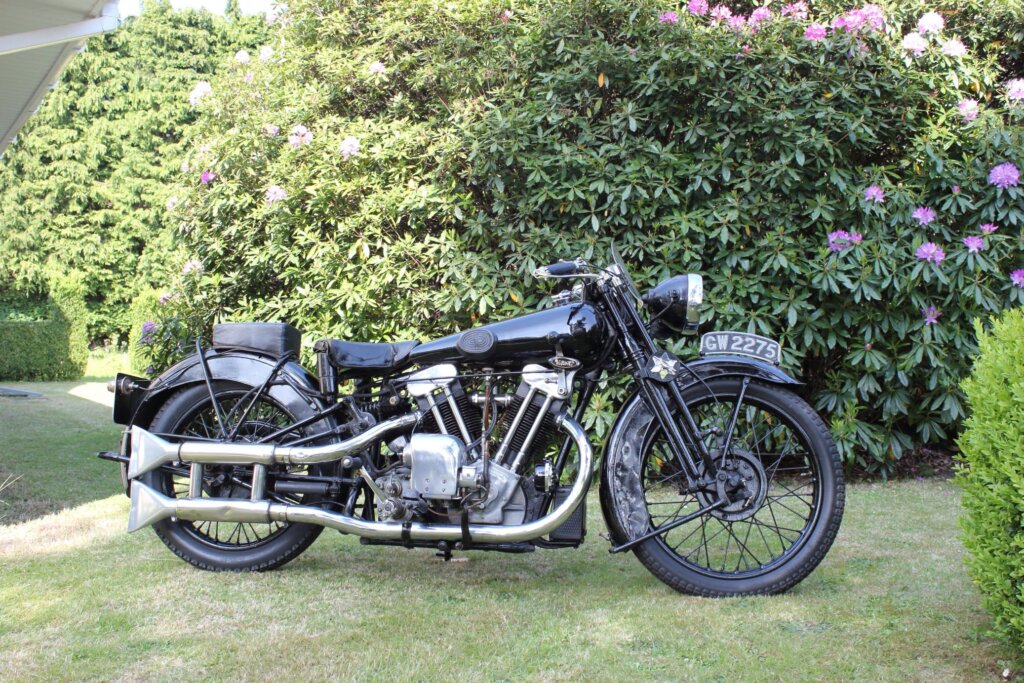
George VII – T E Lawrence’s last Brough Superior SS100 GW 2275. photo: Barry Wooding
It’s arguably the most famous motorcycle in history – the 1932 Brough Superior SS100 that Lawrence of Arabia was riding on 13 May 1935 when he was fatally injured in a crash close to his cottage at Clouds Hill near Bovington – but as the 90th anniversary of his death approaches, where is the bike… and where’s it going… or has it already gone?
The last owner of the bike, registration GW 2275, was reclusive collector John Weekly who lived in St Ives on the Dorset/Hampshire border. He bought it in 1977, for no more than £7,000 and kept it in his lounge, with other bikes in his collection including another Brough Superior, a rare pre-WW2 Norton and a single cylinder Norton 500, stored in his garage.
At various times, GW 2275 was on show at the National Motor Museum in Beaulieu and at the Imperial War Museum in London, before it was returned to him ahead of a major refurbishment in 2014.
“John was very hurt by that, especially when he was told that Lawrence was no longer considered relevant,” says his friend Theresa Jenkins-Teague, a distant relative of Lawence and owner of the Lawrence of Arabia Hotel in Weymouth.
“He was a great admirer of Lawrence and was very proud of the bike as well as several other Lawrence artefacts that he owned.”
John’s fellow motorcycle enthusiast Barry Wooding concurs: “The thing was, when it was out on loan John used to phone the museums every week to ask if the bike was OK, but that was just John – it was his passion.”
John died on 24 January 2024, but in an interview for US-based website barnfinds.com* in 2013, he was reported as saying about GW 2275: “There’s still something about it. It’s not really mine, it will always be his (Lawrence’s). He had a lot of motorcycles, but he kept this one far longer than any other, and it was his favourite.”
John was also clear about what he felt should become of the bike when he died: “I think it should go to a prominent museum that would make sure it’s protected for the future. I think you can have an affinity with mechanical things. This motorcycle is the last thing that Lawrence touched, the last thing he thought about.”
In the 1920s and 1930s, the Brough Superior – and in particular the 100mph SS100 model – was considered the Rolls Royce of motorcycles, the domain of wealthy thrill seekers, renowned for its speed, reliability and handling. Drawn by their racing pedigree, TE Lawrence was bitten by the Brough Superior bug early and bought the first of the seven he owned in 1922, calling it Boanerges or ‘sons of thunder’, before settling on the name George after his friend, the bike’s designer George Brough. Lawrence’s last bike, George VII, was due to be replaced by an eighth machine when he suffered his fatal crash.
“Of course the bike is stunning to look at; it’s a Brough,” beams Barry, who used to run the Brough Superior website for Mark Upham, the vintage motorcycle enthusiast who has owned the marque since 2008.
“I met John through Mark when we set up some filming with the broadcaster and bike fan Andy Kershaw for The One Show. I don’t think it has actually run since the 1980s, but even to be sat on it is a real pinch yourself moment. John and I bonded over motorcycles and although he could be a funny so-and-so, if you got him on bikes you had his full attention. We used to hang out in his kitchen or hallway, sometimes in the garage, but the Lawrence bike was in the lounge when he had it at home.”
Lawrence sustained his fatal head injuries after swerving to avoid two boys on bicycles on the grit and gravel covered road near his home at Clouds Hill. It was a relatively low speed accident, he was probably travelling at or below 30mph, but he wasn’t wearing a helmet and was thrown from the bike. The Brough suffered fairly minor damage – a dented fuel tank, scratches to the silencers, front mudguard and headlamp rim, a bent right handlebar, foot brake and gear lever, and broken foot rest. After the accident the bike was stored in a shed at Bovington Camp then taken on a coal truck and entered into evidence at the Inquest, which took place at the Camp’s Military Hospital on the morning of Lawrence’s funeral at St Nicholas Church, Moreton.
Afterwards, Lawrence’s brother Arnold had the bike returned to Brough who replaced the tank and brake and sold it to a dealership in Cambridge where it was advertised as having belonged to Colonel Lawrence. Subsequently, it had several owners and according to some accounts changed hands for £1 in the early 1960s, with a sidecar, before being gently restored largely using the original parts.
“John kept it as he bought it, so when I saw it, it was clear the fuel tank had been hand painted with black enamel thereby trapping any potential evidence beneath,” says Barry. “There have always been theories regarding the crash and who or what might have been responsible, so perhaps there’s a possibility of an investigation one day.”
However, the current whereabouts of GW 2275 are unknown. Interest in the bike is global and it’s difficult to ignore the possibility that, given a chance, a wealthy collector such as US TV star Jay Leno would return for it. He bought a collection of Broughs from Robert White, the Poole photographer who, following his death from cancer in 2015, funded the £10 million Robert White Centre for cancer treatment at Dorset County Hospital.
Barry Wooding suggests British bike enthusiasts could band together, crowdfunding to raise the funds to keep the Brough in the UK.
“If 5,000 people each put in £500 there’d be £2.5 million, which should be enough to buy it and meet expenses with ownership spread among a lot of people so selling it in future would be quite difficult. The bike could be displayed at the National Motor Museum or at Sammy Miller’s Motorcycle Museum in Bashley.”
It seems simple enough, and who wouldn’t want to be able to see – or snap a selfie with – one of history’s most famous motorcycles? But as with so much of the enduring legend of TE Lawrence, fact and fiction can be difficult to discern, the truth becomes mired in mystery, and history’s lens is unable to focus.
“For more than a century there has been this fascination with Lawrence and the mystery surrounding the bike is quite typical of that,” adds Theresa, who tends the grave of her relative in Moreton Churchyard and, for some 20 years from the early 1980s, was responsible for another Lawrence riddle – the flowers that would mysteriously appear on his grave on the anniversary of his death.
“That was fun, but I am always glad to speak up for Lawrence because he is such an important figure in our history whose legacy is still felt today. John Weekly appreciated that and believed Lawrence’s last Brough should be on show to the public – perhaps the government should ensure that whoever owns it, the bike must not be allowed to leave these shores.”
Will that most illustrious of historic bikes, Lawrence of Arabia’s final Brough Superior, GW 2755, ever be seen again under a Dorset sky? We can but hope…
:: John Weekly’s partner was approached for interview but declined to discuss the matter of GW 2275 at this time.
*https://barnfinds.com/lawrence-arabia-death-brough/
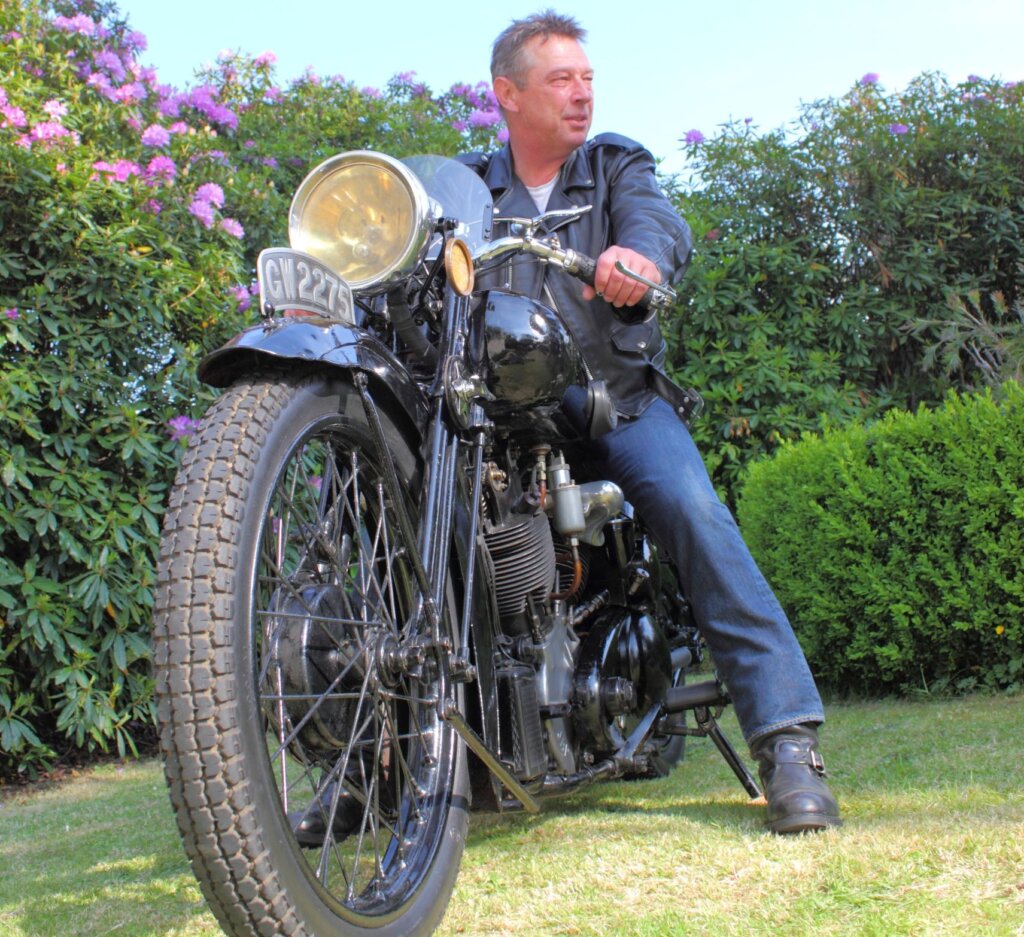
Broadcaster Andy Kershaw aboard GW2275. photo Barry Wooding
Andy Kershaw
“I came across John Weekly and GW 2275 in 2015 after pitching an idea for a film about it to the producers of The One Show. I’d read somewhere that the damage to the bike wasn’t that bad and that it was owned by this reclusive collector near Ringwood. So I tracked him down and he agreed to let us film the bike but wouldn’t appear on camera. Instead, he offered his friend Barry to be a sort of spokesman for him, which is how I met Barry.
“The bike wasn’t running but I did sit on it, which is quite something. I’ve ridden Broughs before and, in my opinion, the SS100 is a bloody nightmare! The wheel base is so long that you get the feeling it doesn’t want to go round even the most sweeping of bends so it’s a panic at every corner, plus the brakes are totally inadequate for a bike of that size and weight. However, it’s a lovely engine, the real power of it, the lovely thump of the big JAP V Twin, it wouldn’t be my road motorcycle of choice but lovely for standing in your living room, which is where John kept it – he wheeled it out from his living room for us to film.
“But why I’m so concerned about this bike is that I asked John about what he hoped would happen to the bike and he said it was his hope that he could leave it for the nation for us all to see. Now, given the news that John has passed away and that some of his collection has been auctioned, the dread fear is that GW 2275 has already gone by private sale and we don’t even know it.
“If I have any role in this it could be that I know lots of vintage motorcycle collectors, some of which have deep pockets, so perhaps some kind of syndicate could be formed. It would take an awful lot of spare fivers and tenners to buy it, but if ownership was shared somehow there’s a chance it could be on permanent public display.”
The fuss about Brough
Some 3,050 Brough Superior motorcycles were manufactured from the early 1920s until World War 2 halted production in 1940, of which about a third are thought to still exist. In Lawrence’s day, a new Brough would have cost around £150 – more than a family house and as much as two years’ pay for the recruits Lawrence served alongside at Bovington. The world record for a Brough Superior SS100 like the ones Lawrence rode dates from 2019 and stands at £424,500 – it wasn’t even fully assembled!
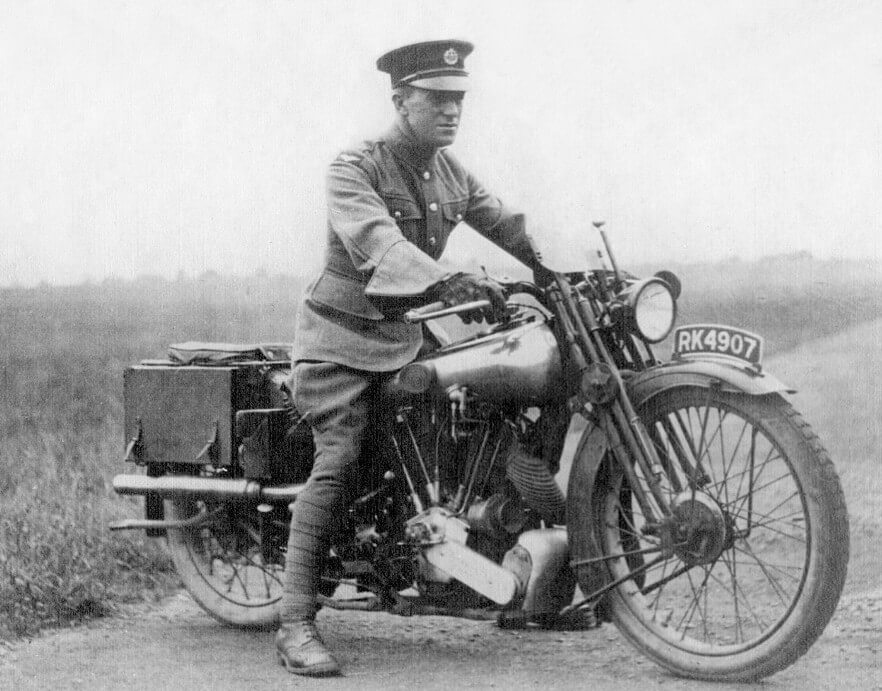
Lawrence on his earlier Brough, George V
A national hero
The reputation of Colonel TE Lawrence, Lawrence of Arabia, was forged during World War I in which he served as British intelligence officer in Cairo at the time of the Arab Revolt in June 1916. He led the revolt to victory against the German-supporting Turkish army, effectively redrawing the map of the Middle East in favour of Britain and her allies.
However, his heroics were initially overshadowed by the horrors of the Western Front and it wasn’t until 1919 that his remarkable story became known to the wider public thanks to the sensationalist efforts of American film maker Lowell Thomas.
He became a national hero, but found himself ill-suited to celebrity status. Feeling he had somehow betrayed the trust of his Arab comrades, he sought refuge in anonymity, taking assumed names to enlist in the RAF and then the Royal Tank Corps at Bovington where he rented then bought his cottage at Clouds Hill.
His legacy continues to be felt to this day, not only in the geo-politics of the Middle East, but far closer to home. Lawrence’s death deeply affected one of the doctors who treated him, a young neuro-surgeon called Hugh Cairns, who realised that his life might have been saved if he had been wearing a helmet. At the start of World War 2, as a consulting neuro-surgeon to the British Army, Cairns researched head trauma in military dispatch riders and in 1941, as a result of his subsequent report, it was made compulsory for military motorcyclists to wear crash helmets. In 1973, the wearing of crash helmets for all riders became law.
More information at:
https://www.thelawrenceofarabiahotel.com/en-GB
https://www.nationaltrust.org.uk/visit/dorset/clouds-hill
https://www.stnicholasmoreton.org.uk
https://www.facebook.com/warehammuseum