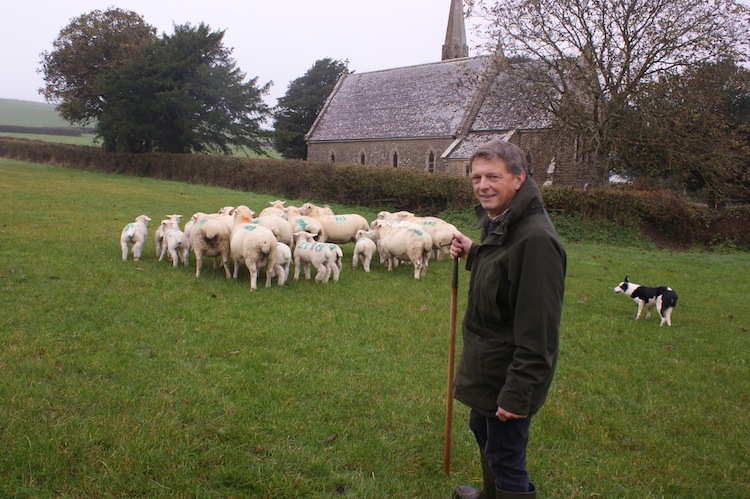
Grazing the hills and fields around North Poorton, as they have for more than a century, these Dorset Horn sheep are more precious than they could ever know – for they have the endangered breed’s longest pure bloodline in the country, and in all likelihood, the world.
Beautifully proportioned, sturdy, docile and unerringly versatile, these sheep are as easy to work with as they are on the eye. That’s according to Francis Fooks, who with brothers Michael, David and Jeffrey, farms the land their grandfather took on in 1920 with its flock of Dorset Horns established by their great grandfather in 1906.
‘A photographer once told me these sheep look like they’ve grown out of the soil they stand on and I’ve never heard it better put – they just belong here,’ says Francis, a Council member of the Dorset Horn and Poll Dorset Sheep Breeders’ Association.
That august body was founded in 1891, but the breed dates at least from the mid-19th century with some sources claiming it is documented as far back as the 17th century. In the 1980s there were more than 100,000 breeding Dorset Horn ewes and although the Rare Breeds Survival Trust now lists it as ‘at risk’, the Society has seen signs that the bloodline is widening due to a resurgence of interest in the breed.
The Dorset Horn, white faced and white fleeced with distinctive pink nostrils, is not to be confused with the smaller, black-faced Dorset Down breed. But the Poll Dorset was bred in Australia in the first half of the 20th century by crossing the widely exported Dorset Horn with hornless Corriedale and Ryeland sheep then introduced to the UK in the mid-1950s by, among others, a man well known in Dorset sheep circles, Bunny Lenthall, who farmed at Burton Bradstock.
‘Bunny was great friends with our family,’ recalls Francis. ‘Dorset sheep breeders are a friendly bunch, very easy to get along with, much like the breed I suppose.’
Trading as Fooks Brothers the family has always run a mixed farm with rotational crops, a dairy herd and a flock that now runs to more than 200 ewes, about a third of which are Dorset Horn and the rest Poll Dorset.
‘Essentially they are the same sheep with or without horns, it’s just that for obvious reasons the Poll Dorset is easier to manage. Both are lovely breeds, the only down side, and the reason some shearers hate them, is that they’re not very comfortable being sat down. As soon as you put them on their backsides to work on them they twist and pull and flail around.’
Speaking as some would of much-treasured machinery, Francis makes this sound more like a quirk than a fault and the affection with which he regards his ovine charges is plain.
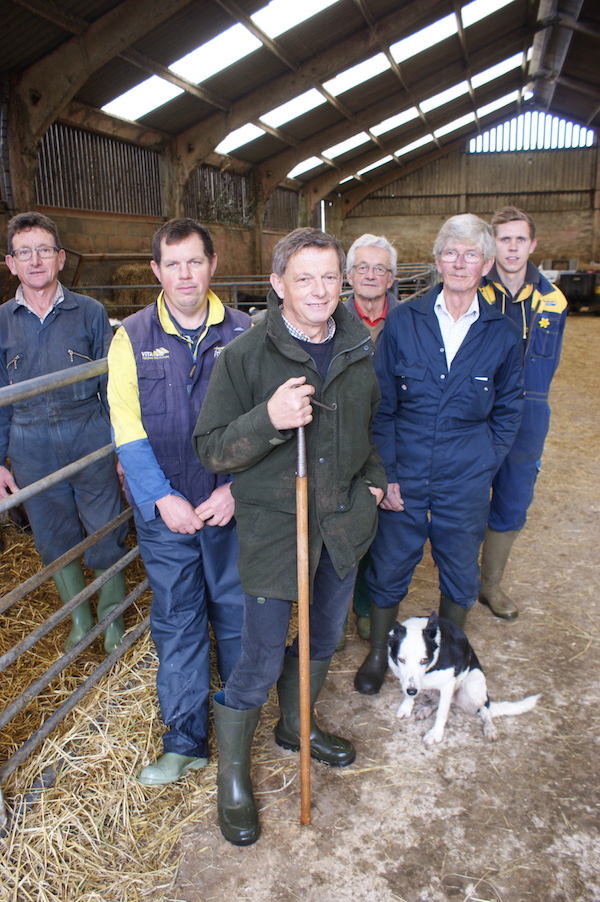
‘You pretty much have to love sheep to work with them and as with any type of farming you have to have a feel for it, you have to understand the land. This is what I call dog and stick country, it’s awkward hills and valleys and the soil is not the greatest. So in summer the sheep are up on quite poor soil, but once the cows have gone in the sheep come on to the better pasture and land where we grow catch crops – roots, like swedes and turnips, or forage rape. It benefits the soil as well. I think we have to go back to this rotation farming rather than keep growing the same thing in the same place year in year out.’
Dorset has a long history with sheep – the Exon Domesday of 1086 records a population of 22,000 sheep – and generations of Fooks have learned a thing or two about working with them. The brothers’ great grandfather Frederick Henry Fooks farmed sheep from the mid-19th century at Walditch and then at Park Farm, Chideock where he established the flock that was moved to North Poorton by his son Frederick Thomas William Fooks in 1920 who then passed it on to his son, Wilfred, whose sons are now in charge.
‘Father died when I was still at school and our uncle Alan took on the day to day running of the flock until he passed away and I took over from him,’ explains Francis.
‘We’ve got two older sisters as well – Hazel and Christabel, whose son Simon is farming with us now, as is David’s son Nick so the next generation is coming on. My son Adam is also farming, but he’s with a commercial flock of 1500 ewes at Waddon at present although I’d like to think he’d come back here and there’d be another generation of Fooks on this land. In fact, with his son Josh there is potential for another generation of Fooks as masters of the Poorton flock.
‘Things have changed such a lot. When we were growing up there were six farms around North and South Poorton, now there’s just us, but farming has always been a partnership with the land and this hill land is not the easiest, you have to respect it otherwise there’s no way it’ll let you make a living on it.’
And there it is – these muddy lives are all about meeting basic needs, putting food on tables and keeping roofs over heads. Francis explains that although in general there’s little value in the fleeces as the wool trade has declined in recent years, Dorset wool is one of the most sought after from British breeds – it felts very well and is used to make biodegradable woollen coffins. Even so, almost all the Fooks’ produce lamb is sold to Waitrose where it can be bought as ‘New Season Dorset Breed Lamb’ from January to May.
‘It’s a niche product so it’s not in every branch, but the only reason we can do that is because the Dorsets can lamb out of season so they’ll lamb when you want them to. We lamb in the autumn, which means that come the new year those new season lambs are ready and because they grow quickly from birth to slaughter they produce very tender and succulent meat.’
As we head outside to meet some of the flock grazing in a field next to the Church of St Mary Magdalene – built in 1862 with Thomas Hardy assisting the architect John Hicks in his work – Francis reveals the link with Dorset’s best known literary son was sealed in sheep when the Poorton flock was used in the 2015 film of Far From the Madding Crowd… although without much consideration for historical accuracy.
‘I reckon they’d have used any sheep, it just happened they shot a lot of it on land that we farm and they had to use a mixture of Dorset Horn and Poll Dorsets, which didn’t exist at the time of the story of course,’ he laughs, rolling his eyes as he sends his faithful dog Teal to round up the flock for their close up.
• First published in Dorset Life The Dorset Magazine.